Accept a job offer, complete the paperwork, and not show up on the first day. Hold several interviews and stop responding just before closing the process. Join for a few days and disappear without warning. He ghostinga behavior associated for years with personal relationships, dating and, later, transferred to the professional field, has fully entered the selection processes.
A survey conducted by Resume Templates among 1,115 hiring managers in the United States reflects the extent to which this dynamic is beginning to condition the relationship between companies and candidates, especially around Generation Z. 54% of hiring managers claim to have been ignored by a Gen Z candidate after having made them a job offer.
There are also companies that stop responding, processes that last weeks, and offers with no intention of hiring.
The data has fueled the image of a generation less committed to traditional work codes, but photography is more complex. He ghosting It does not only appear at the end of the process nor is it exclusive to young candidates. There are also companies that stop responding, processes that last for weeks, and offers published without a clear intention to hire. The investigation itself thus points to a deeper erosion of trust between both parties.
The disappearance of the candidate takes different forms depending on the moment of the process. Among the responsible people consulted, 22% indicate that they have suffered ghosting before even being able to establish the first contact, while 41% affirm that the candidates stopped responding after that initial approach.
After the interview, the percentage remains high: 38% claim to have lost all communication with candidates after maintaining it. Another 22% point out that some applicants never responded to the offer letter.
The behavior continues even after there is an apparently closed deal. 27% of hiring managers say Gen Z candidates accepted the offer but never completed the necessary paperwork; 26% say they completed the paperwork, but did not show up on the first day; and 29% say they have experienced cases in which the professional started working for a few days or a week and then disappeared without warning.
The cost of “ghosting”
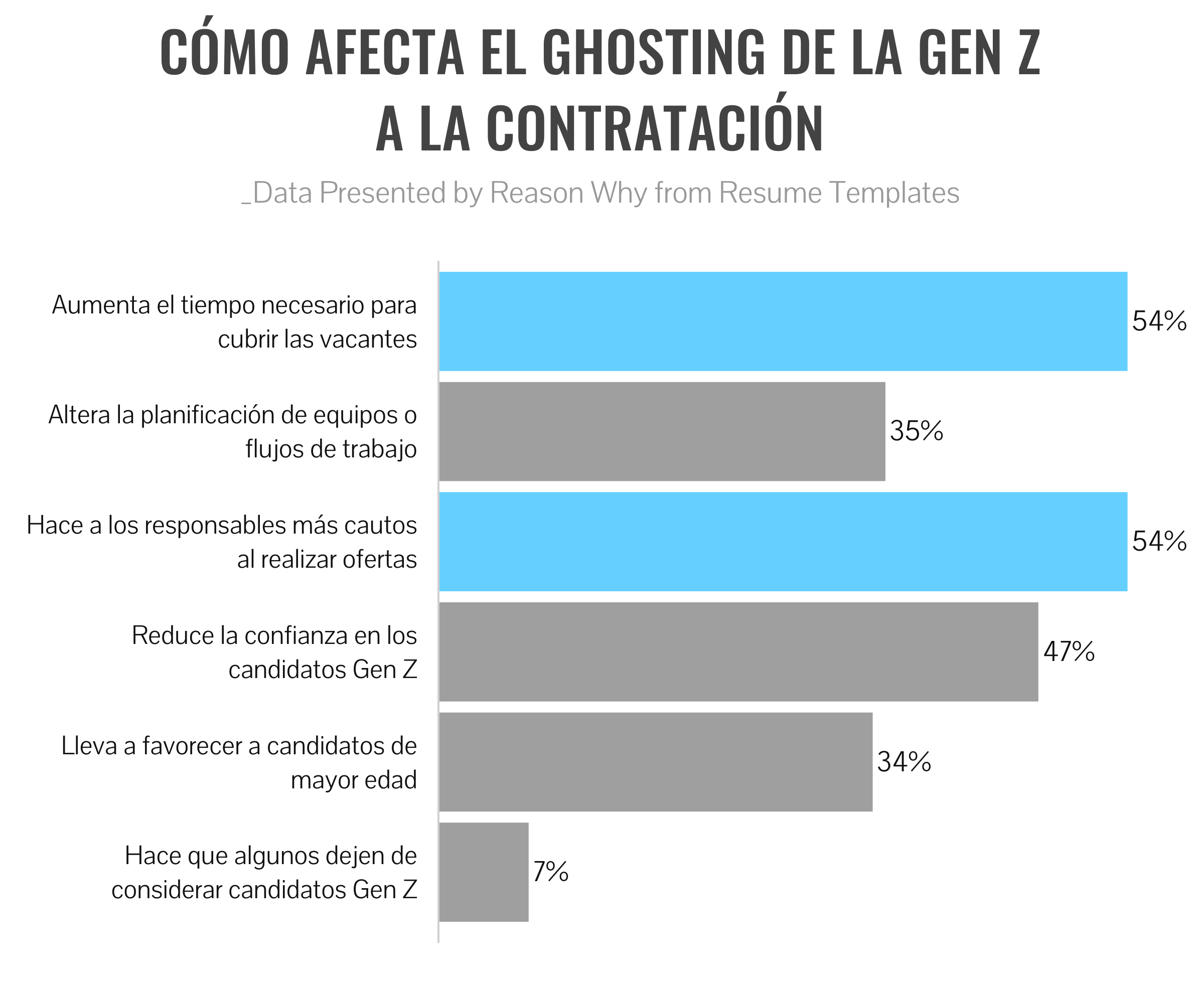
The disappearance of candidates is not limited to an uncomfortable anecdote for Human Resources departments. 66% of managers who have suffered ghosting say that this practice has complicated their hiring processes.
The most widespread consequence is the increase in the time necessary to cover a position: 54% point it out. This same percentage assures that the phenomenon has led them to adopt a more cautious attitude when making new offers.
There are also effects on the perception of young talent. 47% acknowledge that their trust in Generation Z candidates has decreased, while 34% say they now tend to favor older professionals.
The impact even reaches internal operations. 35% claim that these behaviors have altered team planning or workflows.
But the most extreme data corresponds to those who have directly chosen to exclude. According to the survey, 7% of those responsible who have suffered ghosting with Gen Z candidates claim that they no longer consider professionals from this generation in their selection processes.
Generational reputation can turn against candidates
The perception among employers is especially negative. 86% of hiring managers believe that Generation Z is more likely to make ghosting than previous generations: 53% believe it is somewhat more likely and 33% believe it is much more likely.
This reputation makes small everyday behaviors take on greater importance during a selection process. When managers are asked what signals they use to evaluate the reliability of a Gen Z candidate, 68% mention punctuality in interviews, 65% consistent communication during the process, 64% interest shown through questions, and 62% speed in responses to emails and messages.
36% also consider thank you notes or messages after an interview as a sign of commitment.
“Ghosting has created mistrust on both sides. Maintaining communication can have a big impact”
“In a labor market where ghosting has created mistrust on both sides, small actions like maintaining communication can have a big impact”says Kara Dennison, Head of Career Advising at Resume Templates.
For the expert, the issue is not in demanding extra effort from the candidate, but in maintaining basic professional behaviors: responding, communicating changes in decision and showing real interest throughout the process.
“Ghosting” is not just a candidate thing
The generational interpretation loses force when the other side of the labor market is observed. 75% of employers admit to practicing ghosting at some point in their hiring processes.
Mark Beal, Associate Professor of Professional Practice at Rutgers University, warns precisely against the idea of attributing behavior solely to young people. As he explains, he also regularly hears from Gen Z students who have advanced through multiple rounds of interviews until reaching the final phases and, then, have stopped receiving any response from the company.
For Beal, the expansion of ghosting It is linked to a broader transformation of the employment relationship. Since 2020, the transition towards remote and hybrid models has displaced part of in-person interactions towards more impersonal environments, while tools such as Slack, Teams and Zoom, and later artificial intelligence, have increased technological intermediation between employers and professionals.
Their thesis is that the less personal the relationship between company and candidate is, the easier it is to disappear from it without giving explanations, so that the problem begins even before a specific candidate exists.
And there are also ghost job offers. A Clarify Capital investigation conducted in 2025 on more than 175,000 job offers in the United States identified that approximately one in seven could be considered a “ghost job.” The term refers to vacancies that remain published for more than 30 days without there being a real intention to fill them.
Hiring managers interpret some behaviors as a lack of commitment
Thus, while companies question candidates who disappear after an interview or an offer, some professionals face processes that may never lead to a real hire. The sum of both dynamics feeds a circle of mistrust. Candidates feel that companies can prolong processes, stop responding or keep vacancies open without a path; and hiring managers interpret certain applicant behaviors as a growing lack of commitment.
“Gen Z ghosting is not just a Gen Z problem. It reflects a hiring system that has lost its trust”says Dennison. The expert links this distrust with factors such as processes that are too long, lack of communication or a presentation of the corporate culture that does not subsequently coincide with reality.
Companies are beginning to adapt their processes
Some hiring managers are already reacting. 52% affirm that they communicate expectations of commitment from the first phases; 43% make friendly contacts between the acceptance of the offer and the joining date; and 37% adopt a more informal or conversational style during interviews.
Furthermore, 34% delay sending the formal offer until later stages of the process and 24% incorporate social or integration activities with the team during the process. onboarding to strengthen the bond before incorporation.
Dennison considers it risky to respond to the problem by directly excluding young people. Generation Z constitutes a growing part of the workforce and abandoning it would reduce access to talent and could also generate problems linked to age bias.
Their proposal involves reviewing hiring practices that may no longer work: speed up times, improve communication, establish clear expectations and build a relationship based on transparency and mutual respect.
When companies and candidates begin to assume that the other party can disappear at any moment, trust stops being the starting point of the process and begins to be something that both parties have to earn during it.