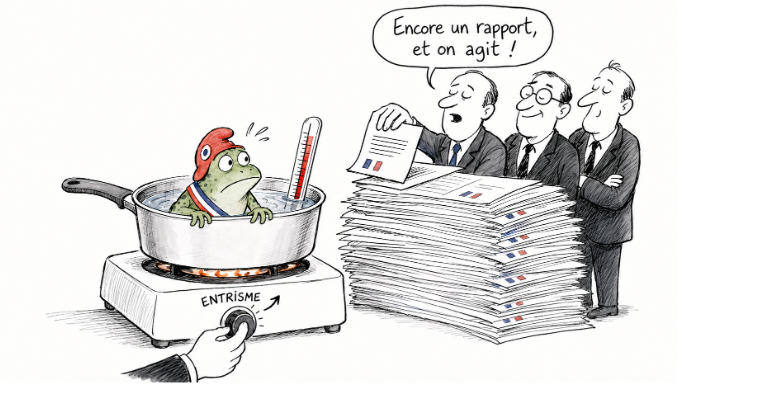
The scene is familiar: plunged into boiling water, a frog would jump to save its skin; installed in cold water heated slowly, it would allow itself to be cooked without realizing the danger. The experiment is scientifically false – the animal tries to escape when the temperature rises – but the metaphor says something right about societies: they react to sudden ruptures and get used to gradual displacements. Faced with political Islam, France no longer lacks warnings. Rather, she risks becoming accustomed to what she has identified.
Terrorism produces an immediate shock: victims, images, an investigation, national mobilization. Entryism never presents itself as an assault. It advances through a succession of initiatives, often legal and, taken separately, sometimes harmless: an association becomes the interlocutor of a neighborhood, a collective demands development, an educational structure disseminates its references, a sports club imposes accommodations, a local manager accepts a breach to buy social peace.
None of these facts are enough to prove a strategy. This is precisely where the difficulty lies: the phenomenon can only be read in accumulation, the links between organizations, the circulation of executives and the convergence of discourses. What the Republic could refuse in one piece, it sometimes ends up accepting in fragments. The alert threshold shifts, then the new state of affairs becomes the norm.
The report published in May 2025 by the Ministry of the Interior gave a measure of the phenomenon: between 400 and 1,000 Brotherhood activists, 139 places of worship affiliated with Muslims of France – or around 7% of Muslim places of worship – and 21 educational establishments linked to or deemed close to this movement. These figures must be read with rigor. They describe neither an imminent conquest nor the millions of French Muslims, who cannot be confused with a political project. The report even notes the decline of certain historical structures. But it documents an ecosystem capable of acting over the long term, where the State and the parties reason according to the rhythm of mandates.
The Republic sees the danger, but gets used to the alert
To say that France “sees nothing” would now be inaccurate. The 2025 report was followed by defense advice. A commission of inquiry of the National Assembly worked on the links between political leaders and networks propagating Islamist ideology. On May 5, 2026, the Senate adopted, by 208 votes to 124, a bill against Islamist entryism, then transmitted to the Assembly.
The question is therefore less one of denial than of inertia. Each alert is followed by a report, a controversy, an announcement, then public attention shifts. Meanwhile, local governments sometimes lack the means to control subsidies, track funding or distinguish between the religious association, the community actor and the activist organization. Elected officials, deprived of field relays, may be tempted to recognize as representatives of a population those who have themselves imposed themselves as such.
This is how the water temperature increases: not by a spectacular decision, but by the progressive delegation of political and social functions to actors whose objective may be to make religious norms prevail over common law. The success of political Islam would then not be measured by the number of its adherents, but by its capacity to change the behavior of all.
Get out of the pot without breaking the rule of law
The mistake, however, would be to transform vigilance into generalized suspicion. Confusing Islam and Islamism would offer the Muslim Brotherhood their best argument: presenting themselves as the defenders of all Muslims and locking them into community representation. A democracy does not fight an ideology by weakening its own principles.
The response must target actions, flows and strategies, not beliefs: transparency of funding, effective control of subsidies, mapping of links between structures, training of elected officials and public agents, strict conditioning of public money to respect common rules, legally solid sanctions against pressure and discrimination. It also involves supporting Muslims who refuse to be assigned to political Islam and stopping looking for a single spokesperson for a diverse population.
The frog fable is scientifically false. Politically, it retains all its strength: societies do not always die from a major upheaval; they can give up in small concessions what they would never have given up all at once. France now has the thermometer. It remains to be seen whether it will have the will to act before the exception becomes the habit, and the habit a new norm.