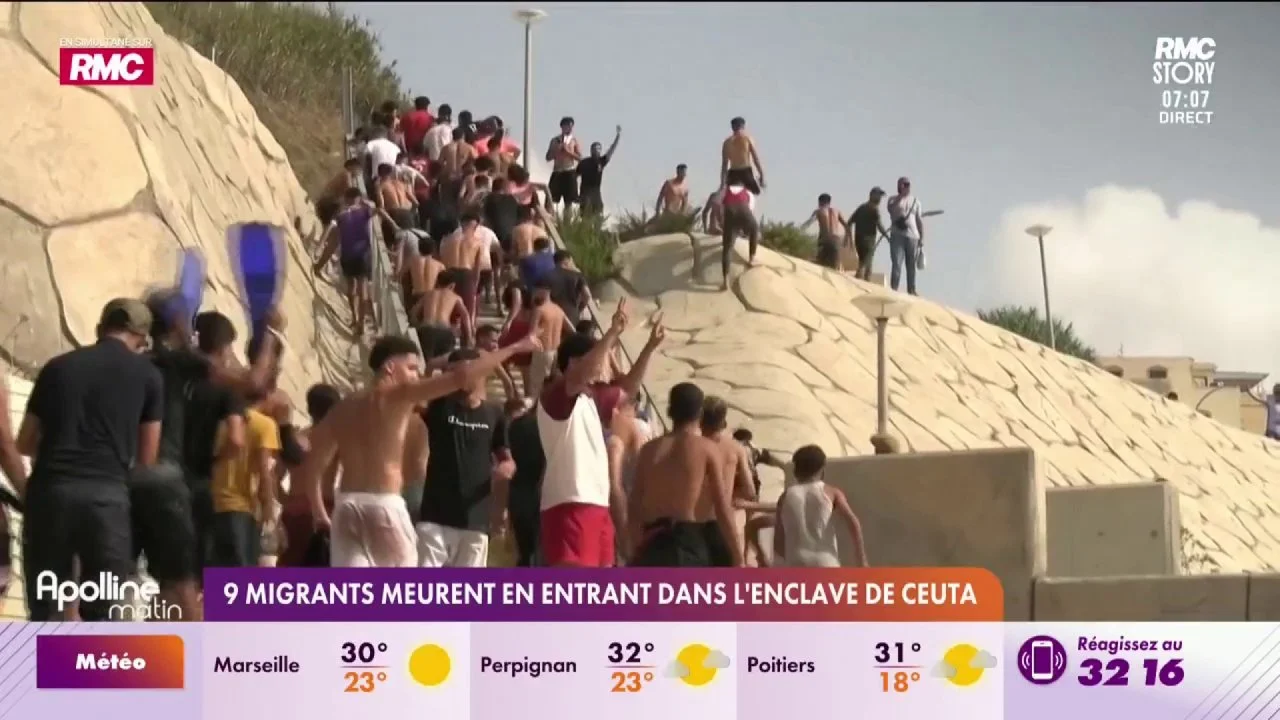
Since Thursday, the Spanish enclave of Ceuta, on the northern coast of Morocco, has been experiencing a completely extraordinary situation. According to estimates from the Spanish Ministry of the Interior communicated this Friday, nearly 60,000 migrants crossed the border between Morocco and Ceuta by sea and land in the space of 24 hours.
A figure which far exceeds anything the enclave had experienced so far, including the crisis of May 2021 (around 10,000 people in two days). At least 34 people died attempting the crossing. The neighboring town of Melilla is also affected, with around 400 additional entries overnight. Behind this sudden excitement, a specific event is on the minds of all observers: a court decision which changed, overnight, the rules of the game at the border.
What is happening in Ceuta and Melilla
Everything happened very quickly. On Thursday, hundreds of migrants – the vast majority men and teenagers – swam to the coast of Ceuta, sometimes equipped with buoys, fins or neoprene suits, while others crossed a border post in the south of the territory. Spanish public television TVE then mentioned 2,000 to 3,000 passages on Thursday alone. But it was during the night from Thursday to Friday that the situation changed to a completely different scale, with the estimate of nearly 49,000 crossings communicated Friday morning by the Ministry of the Interior.
In Melilla, the only official border post with Morocco, that of Beni Enzar, was closed Thursday evening without a reopening date, after clashes described as more violent than anything the border had experienced since 2021: stone throwing, shooting and a bus set on fire, according to police sources.
The president of the autonomous city of Ceuta, Juan Jesús Vivas, warned of the total saturation of reception centers, some far exceeding their capacity, forcing hundreds of people to sleep outside. Faced with the scale of the phenomenon, Spain deployed military units to reinforce the police and the Civil Guard.
The provision that changed everything: the end of automatic pushbacks by sea

According to several Spanish and Moroccan media, this excitement has its origins in a ruling rendered this summer by the Spanish Supreme Court. Until now, a provision of the law on foreigners – the famous special regime of Ceuta and Melilla, introduced in 2015 – allowed the authorities to immediately return migrants intercepted at the border to Morocco, without individual examination of their situation. This is what we call in Spain the “developments in the air”or hot pushbacks.
Seized by an Algerian national returned after having reached Ceuta by swimming, the high court ruled: this exceptional regime, designed for land crossings of the border fence, does not apply to people who enter Spanish territory by sea. Concretely, a migrant who swims to Ceuta can no longer be automatically returned to the other side of the border: his case must now be the subject of an individual examination, with the guarantees procedural implications that this entails.
This legal clarification, seemingly technical, had an immediate effect on the ground. The news spread very quickly among the candidates for exile living on the Moroccan side, notably in Fnideq, a town bordering Ceuta, where rumors relayed on social networks convinced hundreds of people to try their luck in just a few hours.
Why does this decision carry such weight?

The subject is sensitive because it touches on a long-standing point of friction between Spain and the European Court of Human Rights. The practice of hot pushbacks had already been validated by the Spanish Constitutional Court in 2020, then reinforced by a judgment of the Grand Chamber of the ECHR, which admitted this exceptional regime for land crossings of fences.
But this framework had, until this summer, never been explicitly tested for arrivals by sea – a void that the Supreme Court has just filled, by opting for a restrictive reading which excludes swimmers from this exceptional regime.
Political reactions

The President of the Spanish Government Pedro Sánchez is expected in Ceuta this Friday, accompanied by the Minister of the Interior Fernando Grande-Marlaska, to observe the situation on site: meeting with the police at the Tarajal border, then coordination meeting with the regional authorities. The Spanish government insists on its desire to continue to apply the legal framework now established by the courts, while maintaining, according to Madrid, close cooperation with Rabat to organize the return “as soon as possible” people who entered illegally.
The president of Ceuta, for his part, is calling for the creation of a single command to coordinate state services and a reform of the law to speed up procedures. On the right, the People’s Party denounces a national security crisis, while Vox calls for strengthened border controls and systematic returns.
The crisis also took an unexpected diplomatic turn with Italy. The President of the Council Giorgia Meloni announced that she was studying a suspension of the Schengen agreement with Spain, citing concerns “impressive images” coming from Ceuta. A position also defended by its Minister of Foreign Affairs Antonio Tajani and to which Finland provided its support through its Minister of the Interior, Mari Rantanen.
A position also defended by his Minister of Foreign Affairs Antonio Tajani. Madrid responded firmly: the head of Spanish diplomacy José Manuel Albares denounced an inappropriate message and summoned the Italian ambassador. For its part, the European Commission proposed reinforcing Frontex to help Spain deal with the situation, while reaffirming that Morocco remained a key partner of the EU on migration issues.