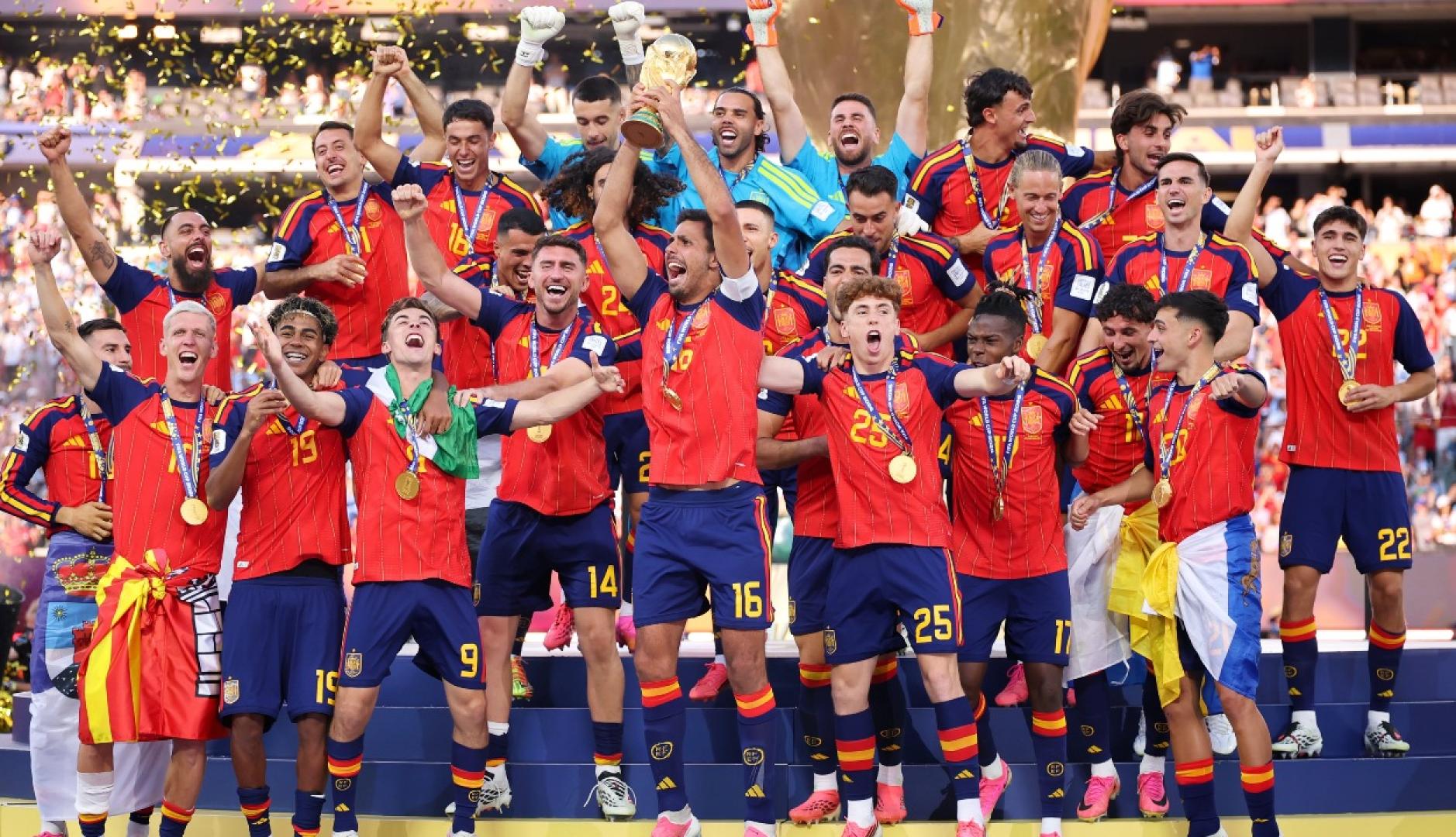
Image: @fifacom
Spain won the men’s World Cup and the country watched it almost entirely on television. The final against Argentina, played on July 19 and resolved 1-0, gathered an average audience of 15,706,000 viewers and reached an 87.1% audience share across La 1, La 2 Cat, Teledeporte and DAZN Mundial, according to the report prepared by Barlovento Comunicación with data from Fifty5Blue.
The data places the match as the second most watched event in history in Spain, only behind the Spain-Portugal penalty shootout in the Euro 2012 semi-finals, which reached 18.1 million viewers. Thus, the 2026 World Cup final was a sporting event and a moment of television concentration that is difficult to compare in the current fragmented ecosystem of audiovisual consumption.
The meeting registered 20,105,000 unique viewers, which means that more than 20 million people watched at least one minute of one of the broadcasts. This nuance is relevant: it does not measure how many people followed the game in its entirety, but rather how many came into contact with the broadcast at some point. The average audience, on the other hand, expresses the average volume of viewers during the entire match broadcast and overtime.
The report also specifies that all the data is calculated by adding the “guests” variable and the accumulated consumption in second homes. That is, in addition to the viewing carried out in the usual home, an expanded measurement is made that incorporates situations that are especially relevant in a summer finale: family reunions, vacation homes, second homes and shared consumption.
The extension raised the tension and so did the audience
The regulation 90 minutes attracted 19,168,000 unique viewers, 15,385,000 average viewers and an 86.3% audience share. Already before extra time, the match had reached an extraordinary magnitude: more than eight out of every ten viewers who were watching television at that moment were following the final.
But the extension increased the concentration even more. The extension reached 18,120,000 unique viewers, 16,608,000 average viewers and an 89.3% share. The data shows something common in large sporting events, but here taken on a larger scale: as the outcome approached, the match retained and added audience.
Spain’s goal brought together 16,973,000 spectators and a 91.1% share
The minute-by-minute curve confirms this behavior. Spain’s goal, recorded at 11:43 p.m., gathered 16,973,000 viewers and a 91.1% audience share. The end of the match, at 00:02 hours, raised the audience to 17,050,000 viewers and 91.7%. The golden minute arrived at 12:01 p.m., with 17,082,000 viewers and a 91.2% share in the sum of the four signals.
The Cup delivery still maintained a very high audience, with 14,304,000 viewers and an 89.2% share at 00:44 hours. The celebration thus functioned as part of the television event itself since millions of viewers remained in front of the screen to witness the symbolic moment of victory.
The 1 concentrated most of the monitoring
Although the report adds data from La 1, La 2 Cat, Teledeporte and DAZN Mundial, the main weight of the broadcast fell on La 1. In the match and overtime as a whole, the public channel gathered 17,778,000 unique viewers, 13,665,000 viewers on average and a 75.8% share.
DAZN Mundial contributed 1,306,000 unique viewers, 891,000 average audience and a 4.9% share. Teledeporte added 1,117,000 unique viewers, 710,000 average and a 3.9% share and 2 Cat registered 767,000 unique viewers, 439,000 average audience and a 2.4% share.
The distribution reflects the strength of linear television in major national events, but also the coexistence with other broadcast windows. The World Cup was mostly followed by La 1, although the addition of complementary signals contributed to expanding the total reach and collecting specific consumption by channel, territory or access preference.
In the regulation 90 minutes, DAZN Mundial had 885,000 viewers on average and a 5% share, while in extra time it reached 908,000 viewers on average and a 4.9% share. The platform thus maintained a stable contribution during the decisive stretch, although La 1’s dominance remained overwhelming.
A transversal phenomenon, with special force among young people
The qualitative profile of the audience shows that the final was a transversal event, but with especially striking strengths in some segments. Among men it reached a 91.1% quota, compared to 83.1% among women. The difference does not prevent us from talking about massive consumption in both groups, but it does confirm a greater male concentration in the final.
By age, the most relevant data is found in young people. The final reached a 95.2% share among viewers aged 13 to 24, the highest percentage of all the groups analyzed. The share among children from 4 to 12 years old and among adults from 25 to 44 years old, both with 94.4%, was also extraordinary.
This data is especially significant for brands, media and audiovisual operators. In a context in which young audiences consume less linear television on a regular basis, a Selection final continues to have the capacity to reorganize habits and bring together groups that are normally dispersed between platforms, social networks and on-demand content in front of a shared screen.
Three out of four people watching television chose the final
The share drops from the age of 65, although it continues at very high levels: 76.7% among viewers aged 65 to 74 and 75.9% among those over 75. Even in the segments with lower relative intensity, three out of four people who were watching television chose the final.
The report also highlights a 93.6% share in the commercial target, which reinforces the value of the party as an advertising medium, with an audience highly concentrated in profiles of interest to advertisers.
Madrid, the Balearic Islands and Andalusia lead by share
The final had a very high implementation throughout the territory, although some communities stood out above average. Madrid reached a 92% quota, the highest regional figure in the report. They were followed by the Balearic Islands, with 89.4%, and Andalusia, with 89.2%.
Murcia was also above or close to the average, with 87.8%; Valencian Community, with 87.5%; Aragón, with 87%; Catalonia, with 86.3%; Canary Islands, with 86.2%; and Castilla-La Mancha, with 85.8%.
The lowest quotas appear in Asturias, with 77.4%, and Galicia, with 81.1%, although even these records maintain an extraordinary magnitude. The territorial data confirms that the final functioned as a first-rate national event, capable of overcoming regional differences, local habits and fragmentation of offer.
An audience that has been growing during the tournament
Spain’s journey in the Men’s Football World Cup shows a clear progression in viewership as the relevance of the matches increased. The previous match against Cape Verde brought together 7,995,000 viewers on average and a 66% share. The previous match against Saudi Arabia rose to 9,754,000 viewers and 68.9%.
The match against Uruguay, broadcast at dawn, had a lower average audience of 4,360,000 viewers, but a share of 79.4%, a reflection of the lower television competition and the attractiveness of the match even in a very demanding slot.
From the playoffs onwards, growth was sustained. The Spain-Austria round of 32 reached 10,835,000 viewers on average and a 71% share. The Portugal-Spain round of 16 match rose to 12,703,000 viewers and 75.2%. The Spain-Belgium quarter-final brought together 11,397,000 spectators and 76.5%. The France-Spain semi-final already marked a decisive leap: 14,514,000 average viewers, 19,380,000 unique viewers and an 81.3% share.
The final was the natural culmination of that curve: 20,105,000 unique viewers, 15,706,000 average viewers and an 87.1% share. Interest grew with the competition, but also with the Spanish sports narrative, until it led to a match that concentrated the television attention of practically the entire country.
The data from the Spain-Argentina final allow us to conclude that, with increasingly fragmented television, large live events continue to be one of the few experiences capable of creating a simultaneous, massive and shared audience.
The final competed against other television channels and also against platforms such as Netflix, social networks, short video, second screens and on-demand consumption. And even so it concentrated an 87.1% share. That figure speaks of good football and also of the capacity of certain events to temporarily recover a logic of collective television that seemed eroded.
For advertisers, a World Cup final won by Spain brings together attention, conversation, belonging, celebration and collective memory. These are very difficult conditions to replicate in other media environments.
The data on young people also confirms that the problem is not that certain generations have abandoned television forever, but that they only return when the content justifies the appointment. The directness, the uncertainty and the cultural relevance continue to have enough strength to bring them together.
Spain won the Men’s Soccer World Cup 1-0 and television recovered one of its great functions: making millions of people see the same thing, at the same time, being able to say that they were there when it happened.
More info: Audience report – Men’s Football World Cup 2026 final