“We have taken our time because we want to be very careful in this area. OpenAl’s mission is to bring intelligence to all of humanity and one of the ways we are doing this is by scaling our business and providing an advertising version of our product.”
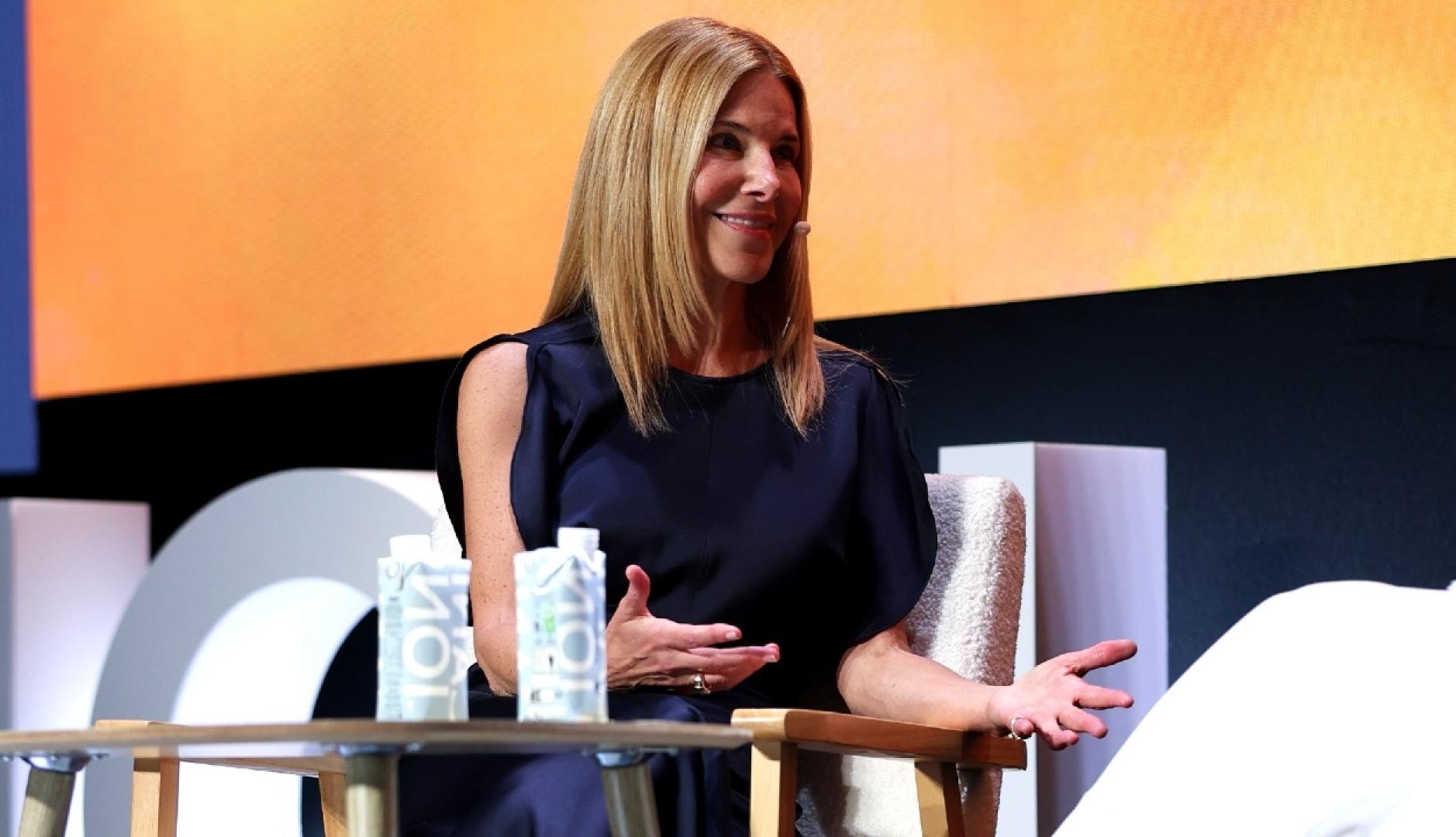
This is how Denise Dresser, Chief Revenue Officer of OpenAI, expressed herself when journalist Julia Boorstin, editor in charge of media and technology at CNBC, asked her about the company’s general strategy for the inclusion of ads in ChatGPT, the artificial intelligence company’s flagship product. Dresser was interviewed by Boorstin in a session of the Cannes Lions conference program under the title “Advertising in the age of artificial intelligence.”
Denise Dresser joined OpenAI last December from Salesforce, where she had worked for fourteen years, and her mission at Sam Altman’s company is to drive revenue from both businesses and consumers. Among the former, publicity plays an important role and Boorstin, taking into account the audience that gathered in the room to listen to Dresser, dedicated an appreciable part of the conversation to the matter. Dresser’s intervention in the Cannes Lions program was the first by an OpenAI professional at the festival’s major advertising event.
It was the first intervention by an OpenAI professional at Cannes Lions
Throughout the conversation, Dresser was, as expected, very enthusiastic about the company’s development possibilities and about the present and future impact of AI on companies, at work and on society in general. Aside from talking about ads, Dresser talked about, among other topics, brand experiences on ChatGPT, the nature of it as a medium, and the risks and opportunities of adopting AI in companies.
Nineteen months and thousands of clients
The goal in including advertising on ChatGPT is, as Dressler noted, to make the product more accessible. “We are moving very slowly, but the response has been amazing. We have been working in the advertising field for only nineteen months and we already have thousands of clients. We have reached seven countries, we are going to continue with the expansion and we are also working on the issue of measurement.”
Dresser also pointed out that the response to this advertising strategy is good “But it is important to make sure that the user experience is excellent. We are thinking a lot about things. Although, from the experience point of view, we are seeing how the percentage of ad closures has decreased because the user does not consider them useful. Relevance increases.”
Asked by Boorstin, at this point, what she thinks ads on ChatGPT should be like to be effective, Dresser responded that the most important thing is that they be useful. “And when I say useful”accurate, “I mean that they are relevant to the topic being talked about and contribute to the conversation”
Will they be different from the ads that appear in search engines?
“Yes, maybe less flashy, more utility-oriented, conversational, and more intelligent about how the product is being used.”
And where will the advertising budgets on ChatGPT, social networks, come from?
“Right now they are coming out of the bucket of experimentation, but over time a new advertising category may arrive. It is a new way of reaching the audience.”
“Over time, ads on ChatGPT may become a new advertising category”
Referring again to the audience of the session, Boorstin mentioned, precisely, his probable interest in using ChatGPT as an advertising medium and asked Dresser for some recommendations on how to take the first steps in the new support. “We are collaborating closely with CMOs and advertising agencies to fully understand the objectives they want to achieve. What is the right content? What creativity is working? We are experimenting and sharing with them what we have learned in the few months in which we have been including advertising, guiding them in the process, advising them. I would say that we are living, in this sense, the same moment as AI in general: we all learn at the same time.”
The role of advertising in revenue
Advertising on ChatGPT not only has an eventual strategic implication in advertisers’ plans; It is also, obviously, a source of income for OpenAI. Julia Boorstin mentioned the company’s plans for corporate clients to generate 50% of the company’s revenue and asked Dresser about the role advertising will play in that regard. The General Director of Revenue responded that it is too early to say and that, obviously, she could not give expected revenue figures, “But we believe that advertising has great potential as we expand our business. The response so far has been incredible.”
Commenting on brands’ activity in relation to artificial intelligence, Dresser also talked about the personalization possibilities that are opening up and how brands are starting to take an interest in what works in that regard. He cited the case of Maybelline, which has developed an application powered by artificial intelligence through which the user can virtually try on the product and see how it looks on them.

“It is currently on their website”he explained, “but they are going to take it to ChatGPT, which is becoming a site where users no longer go just to search but to do something, and in 20% of the cases that has a commercial intention”.
In line with this matter, and about OpenAI’s vision of brand experiences in ChatGPT, Dresser said that it is in the experimentation phase and that the company wants, above all, for them to be useful for the user, not to be intrusive and to integrate naturally into what the user is doing.
The relationship between OpenAI and the advertising sector is not limited to the progressive implementation of ChatGPT as support for including advertisements. It also includes the effect that intelligence tools are having and will have in the future on the work of advertisers and agencies. When the interviewer asked Dresser about the impact of AI on the sector, Dresser said that it is materializing above all in transformation and knowledge.
“Let’s think about an advertiser who has to plan a campaign, prepare the briefing, do research, examine the executions… All of this can be done better and faster, the advertiser is more empowered and has more capacity to act”said. “As far as creativity is concerned, the transition from idea to execution can be done more quickly and on a larger scale. I believe that a new form of advertising is emerging: we are moving from the economy of notoriety to that of intelligence. Users have a deeper intention and the usefulness of campaigns will have to be taken more into account.”
CEOs who get involved
The topics related to advertising were discussed in the first part of the interview and then it turned to more general questions about the adoption of artificial intelligence by companies and the impact that it already has, and may have later, on business, at work and on society as a whole.
“A lesson that companies that are working with AI and testing its capabilities have learned”Dressler commented on these topics, “This is not just about a technological transformation, but about the business as a whole. Thinking about AI solely from technology has not given the expected results, so now CEOs and boards of directors are approaching it from an exponential perspective, reimagining entire workflows and sectors, beyond mere productivity.”
“Thinking about AI exclusively in technological terms has not brought the results that were expected”
Following these statements, and based on the contact with the companies he has as a result of his position, Boorstin asked Dresser if he has detected common good practices in companies that are using AI as a transformative force. Dresser spoke here about three issues: the involvement of the highest levels of the company, the willingness to truly reimagine the company and provide it with a new vision, and conceive AI not as a technology that is used for specific issues, but as a general platform or substrate of knowledge and collaboration.
On the other hand, the biggest risk, according to the Open AI board, would be “not having got it right the first time but staying on track. It is often simply said that AI has not worked, but the reality is that its implementation is an iterative process. Developing an agent or taking advantage of these technologies is similar to incorporating a new employee: even if they are highly qualified, they need training and context to perform at their best. Therefore, rather than giving up at the first obstacles, we must understand that it is a continuous learning journey.”
At the end of the interview, Dresser returned to this issue: “Our job is to educate people, involve them in the journey, show them the potential. If you are someone who is interested in people and what they can achieve, this is a great time to be alive, to experiment, and I love it.”