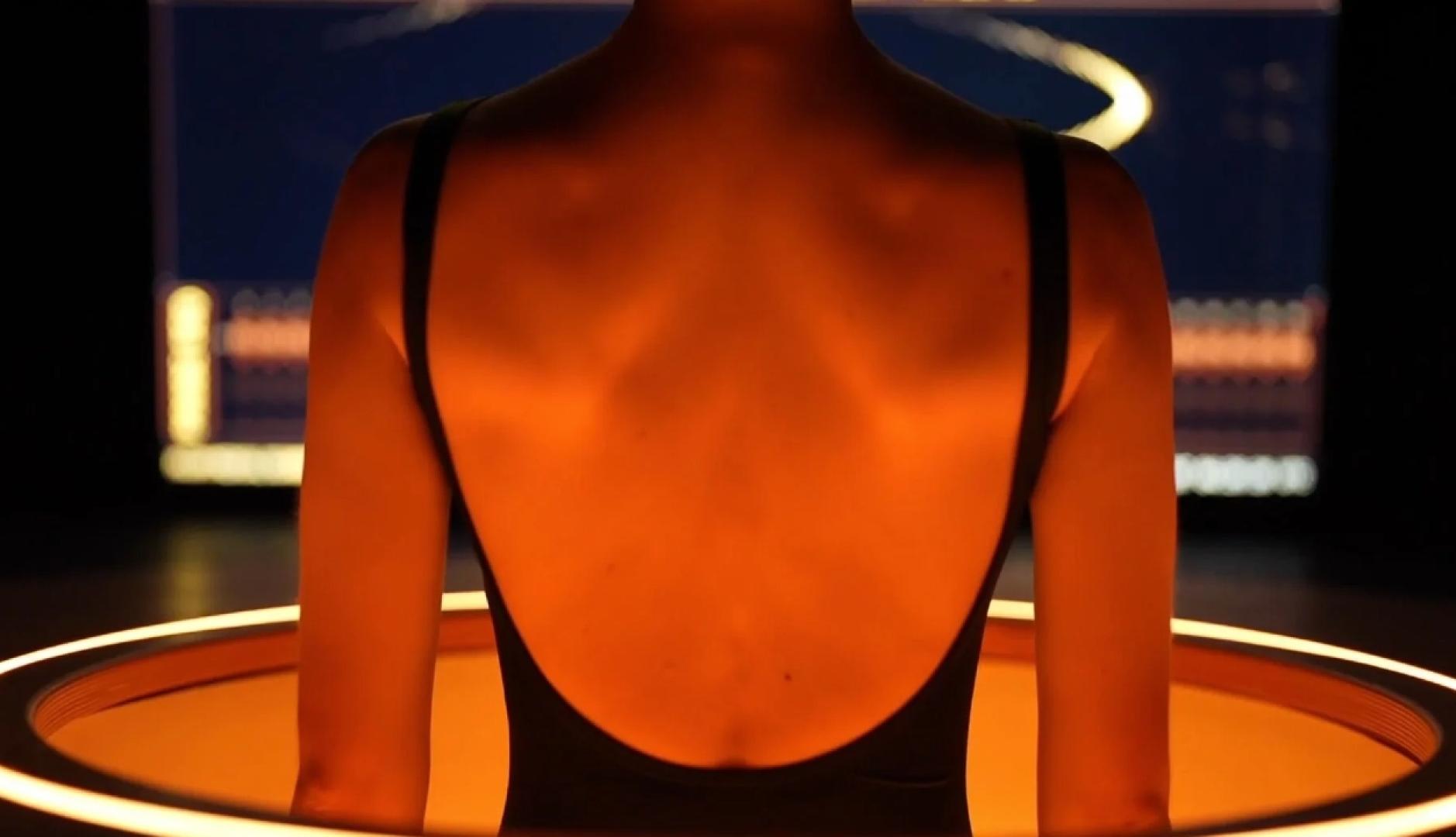
Midjourney, the company known for its image generation tool using artificial intelligence, has presented its first hardware project and a new line of activity far from digital creativity. The company has created Midjourney Medical, a division with which it aims to develop ultrasound-based full body scanners and integrate them into a wellness experience similar to a visit to a spa.
The project is structured around The Midjourney Scanner, a machine that introduces the user into a shallow pool and slowly lowers them through a ring of sensors. These emit ultrasonic waves from multiple angles and record their behavior when passing through tissues with different density or stiffness. The system then processes that information to reconstruct images and a three-dimensional map of the inside of the body. Midjourney places the target duration of each scan at approximately 60 seconds.
The move marks a considerable change for a company whose notoriety has been built around generating images from written instructions. David Holz, Founder and CEO of Midjourney, has presented the project as a new stage for the company and recognized the distance between this development and the generative images that made it popular.
The proposal also combines health technology and a culture of well-being. And Midjourney does not want to place the scanner only in clinics or medical centers, but rather integrate it into spaces where people want to go even if body analysis is not the main reason. The company summarizes its aspiration as the search for a technology as powerful as an MRI and as everyday as a visit to a spa, although this equivalence expresses a corporate ambition that has not yet been clinically demonstrated.
A body scanner inside a pool of golden light
The experience proposed by Midjourney begins on a platform located inside a pool. This descends at a speed of approximately five centimeters per second and makes the body pass through a ring made up of hundreds of thousands of small elements capable of emitting and receiving ultrasonic waves. The company compares the operation of these sensors with the echolocation of dolphins.
The waves change shape as they pass through water, skin, fat, muscles, bones and organs. The system analyzes these variations and uses high computing power to reconstruct sections of the body that are later combined into a three-dimensional representation. The company assures that its goal is to achieve a level of detail less than a millimeter and a speed much higher than that of a full body MRI. These features, however, correspond for now to the statements and technical objectives communicated by the company itself.
The development has been carried out with technology from Butterfly Network, a company specialized in ultrasound on a chip. Its Ultrasound-on-Chip system integrates ultrasonic imaging components into semiconductors and is already used in wearable body scanning devices.
Although Midjourney is a company linked to artificial intelligence, the core of image acquisition currently relies on ultrasound, signal processing and computing. AI is used to segment and identify structures within scans, but is not the basis of scanning at this time.
In its first phase, the system will focus on generating body composition maps, including information on muscles, fat, bones and organs. The idea is that people can observe how their body changes over time and relate those variations to diet, exercise or other habits. Midjourney also proposes that users can share their explorations with doctors, trainers, nutritionists or AI-based health tools.
The most unique dimension of the project is Midjourney Spa. The company plans to open its first location in San Francisco at the end of 2027, with ten scanners, saunas, hot baths, cold-water pools and rest spaces illuminated in gold tones. The goal is for the center to operate 24 hours a day and for the body examination to be integrated as an almost incidental part of the visit.
The company imagines a space where you can go alone or with someone, not necessarily for an immediate medical concern. In this experience, the user enters the water, undergoes the scan for approximately one minute and then continues with the wellness circuit. In this way, Midjourney tries to reduce the clinical dimension of imaging tests and present them as a common practice of personal knowledge.
The approach responds to the intention of making explorations more frequent, faster and accessible. The company maintains that having a library of body images over time could help identify changes and encourage preventive decisions. This is a hypothesis that must be validated in research and whose usefulness will depend on the quality of the images, the professional interpretation and the ultimately authorized uses.
The San Francisco opening will initially operate as a “research spa,” where Midjourney hopes to perfect the hardware, algorithms, operations and user experience. Over the next twelve months, the company will work on a second generation of the device and on trials aimed at demonstrating its technical capabilities.
Midjourney has drawn up a particularly ambitious roadmap. Its stated goal is to have more than 50,000 scanners worldwide by 2031, with a combined capacity to perform up to 1 billion scans per month. The company proposes that this infrastructure would allow periodic analyzes to be offered to a significant part of the world’s population.
The company also maintains that greater availability of preventive imaging could significantly reduce mortality and healthcare costs. These projections are part of their long-term vision and are not yet supported by publicly presented clinical evidence.
For now, the project is in the development phase and its first commercial materialization will not arrive until the end of 2027. But the image it proposes is already singular enough: entering a spa, submerging for a minute in a pool of golden light and leaving with a three-dimensional map of the interior of the body.
More info: Midjourney Medical