On TikTok, trends appear, expand, mutate and disappear at a pace that forces brands to review their way of producing and participating in the social conversation. And not all of them have the same journey. Almost half of TikTok trends disappear within five days and only 27% remain relevant for more than two weeks, according to a study carried out by Publicis Groupe APAC and TikTok itself.
The report analyzes millions of data points in seven markets – Thailand, Indonesia, Vietnam, the United States, the United Kingdom, Germany and Japan – by tracking the top 200 TikTok hashtags in 16 categories daily for six months. The objective has been to identify why some trends sell out in a matter of days while others manage to travel between countries, be reinterpreted by different communities and remain relevant for weeks or even months.
Longevity, not initial virality, is the true indicator of impact
The main conclusion of the study is that longevity, and not initial virality, is the true indicator of impact. In an environment in which many brands continue to try to react to the latest visible trend, the analysis of Publicis and TikTok suggests that the strategic value lies in detecting patterns of persistence: ideas capable of being sustained because they activate shared emotions, everyday behaviors or easily recognizable and reusable codes.
Thus, the report distinguishes between trends that generate a quick peak of attention and those that acquire cultural significance. The first ones usually depend on a joke, a reaction, a piece of news or a specific moment. They work while the context is alive, but they offer hardly any possibilities for reinterpretation. Once seen, they are consumed but do not necessarily invite return or participation.
The trends that last operate in a different way. They are not always the most striking nor the ones that grow the fastest, but they are the most adaptable. They tend to rely on shared human emotions, repeated behaviors, or simple creative structures that allow different users to make their own version. This capacity for community appropriation is what multiplies its useful life.
The study identifies two major types of trends with a greater capacity to exceed two weeks of relevance. On the one hand, useful trends, based on tips, tricks, learning or practical formats that users replicate. An example cited in the analysis is the Vietnamese hashtag #Meovat, which can be translated as “advice” or “tips.” It works as a kind of collective classroom in which creators share cleaning, cooking or daily life tricks, and other users save them to try or publish their own version.
The second type is that of tendencies anchored in cultural codes or shared traditions. In this case, the report mentions #DanjiriFestival, linked to a centenary festival in Osaka, which found new life on TikTok through the creators’ storytelling. The festival was not new, but the way it was told allowed a local expression to be perceived as discoverable.
Southeast Asia functions as a cultural corridor
One of the most relevant findings of the report has to do with the geographical circulation of trends. Publicis and TikTok point out that Southeast Asia is the most connected cultural corridor on the platform. Markets such as Thailand, Indonesia and Vietnam share a very high proportion of trending content, despite their linguistic diversity.
According to the study, campaigns activated in a Southeast Asian market have a 60% to 70% chance of gaining traction in neighboring countries within days, provided the format is designed to be reinterpreted. The implication for brands is significant: in certain regions, culture does not move along national borders; It does so through clusters of behavior, humor, aesthetics, and platform use.
This pattern challenges traditional country planning models. Historically, many brands have organized their campaigns around national markets, with local adaptations of a global message. But on TikTok, according to the report, the speed of cultural circulation requires designing a creative structure capable of traveling through regional corridors and not limiting itself to translating a piece from one country to another.
In the case of Southeast Asia, affinity depends on shared formats, humorous sensibility, visual codes and social behaviors, beyond language. In markets where social commerce is growing strongly, this circulation can also have immediate commercial consequences. A trend born in Jakarta can influence a purchasing decision in Ho Chi Minh in the same 24-hour cycle.
In contrast, Japan appears in the report as a much more autonomous ecosystem. Its trend overlap with neighboring markets is low and responds to its own dynamics of aesthetics, creator, humor and narrative. For brands, this means that a regional strategy copied without adaptation is very likely to fail.
For their part, Western markets – including some non-English speaking ones – behave more closely together. This suggests that certain creative assets in English or Western formats may travel with less adaptation within that block, although always conditioned by the degree of participation they allow.
Formats travel better than messages
The report insists on an idea that is especially relevant for marketing teams: on TikTok, formats travel better than messages. Trends built on clear visual templates, adaptable sounds, transitions or simple mechanics tend to expand and last longer than pieces that are overly narrative or focused on a closed verbal idea.
The reason is that the easier it is to participate, the more likely a trend is to escalate. A transition, a sound or a visual pattern allows each creator to adapt the idea to their context without having to reproduce the original message exactly. The brand provides structure and the community provides variation.
The study points out that strong formats can sustain momentum between 60 and 150 days
Thus, the study points out that strong formats can sustain the momentum between 60 and 150 days. This changes the conversation about effectiveness. As opposed to measurement focused solely on impressions, views, or immediate reach, Publicis proposes looking at earned engagement: the ability of an idea to continue generating versions, remixes, and appropriations for weeks.
This reading questions the impulse of many brands to produce content that is too polished, closed or controlled. On TikTok, overproduction can work against engagement because users are quick to detect when a brand is late to a conversation or trying to insert itself into a trend without understanding its logic. The risk here is the perception of imposture.
Hence the report recommends designing flexible creative frameworks. Brands need to define which elements are fixed – for example, claims, product use, legal issues, visual identity or sensitive messages – and which elements can be left open to the creator’s voice, humor, sound or formal reinterpretation. Brand coherence does not disappear, but it stops imposing itself like a rigid script.
Creators make trends last
Another of the central points of the analysis is the role of the creators. The report concludes that trends co-created with these profiles show higher remix rates and greater persistence than ideas launched unilaterally by brands. And on TikTok, creators do not function solely as amplification channels: they are interpreters of the platform’s language, detectors of community codes and agents capable of adapting an idea to a tone that is legitimate for their audience. When they participate from the ideation phase, they help design a format that others can adopt.
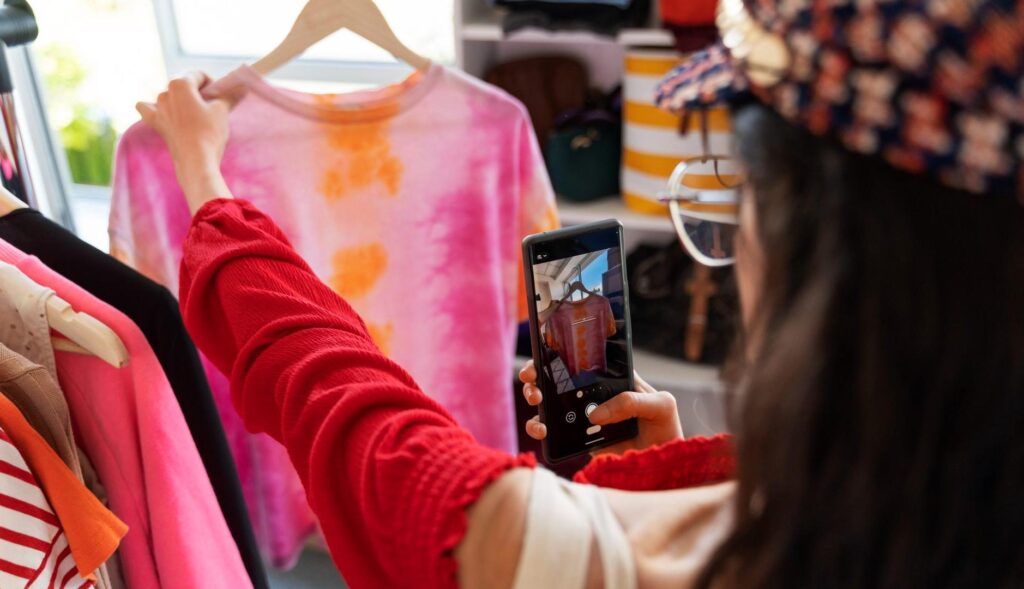
Video source: @chermycloset.
Miu Miu innovated in PR by turning the unboxing of its new fragrance into an ice cream “tasting.”
“At Publicis we see that culture on TikTok does not spread by chance: it scales through participation. This deciphers why some ideas persist and how participation transforms cultural momentum into lasting impact for brands,” said Sapna Nemani, Chief Solutions Officer of Publicis Groupe Asia Pacific.
From TikTok, Shant Oknayan, Vice President of Global Business Solutions, has pointed in the same direction: “On TikTok, creativity travels further and faster when it is powered by people.”
The report’s conclusions point to a change in mentality. Instead of chasing trends when they’re already visible, brands should develop systems to identify persistent signals before they peak. This means investing in real-time listening, incorporating cultural reviews into weekly planning, and observing what grows, what is repeated, saved, adapted, and shared across communities.
Publicis proposes to treat the trend-sensing as an internal capacity. This means equipping brand teams with live dashboards, agile decision processes and clear criteria to distinguish between a fad and a cultural signal with potential.