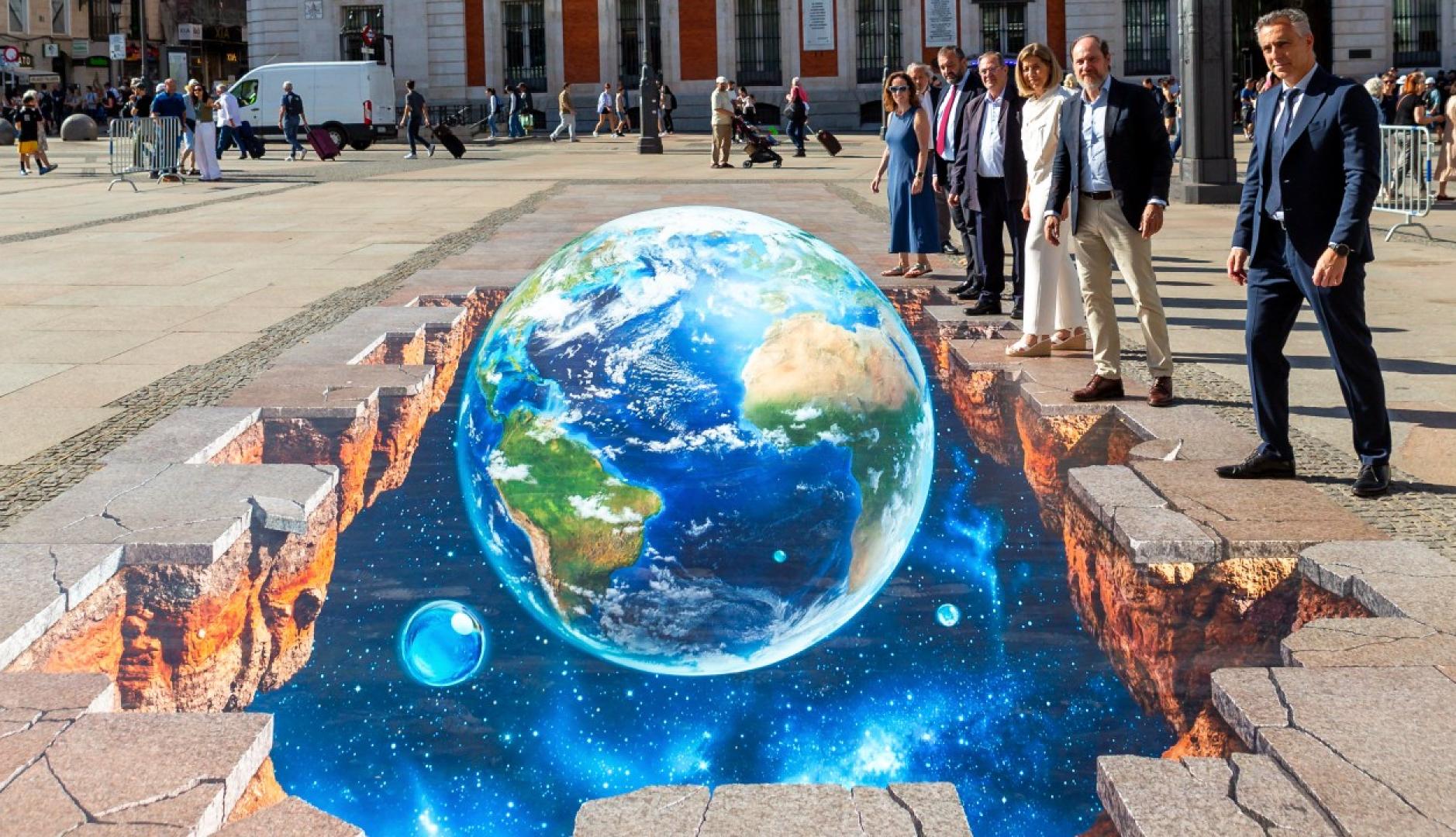
Starting this week, Puerta del Sol in Madrid hosts “Blue Planet, Planet Water?”, an environmental artistic installation promoted by the Canal Foundation that transforms the pavement of the center of the capital into a great optical illusion to raise awareness about the responsible use of water.
The intervention will remain active until July 19 and consists of an anamorphic illustration of 97 square meters designed to be observed from a specific point. From that perspective, the work generates the visual effect of a huge sinkhole in the ground over which several suspended spheres float.
The piece has been created by Pilar Balsalobre and Carlos Jiménez, founders of Photo Alquimia Studio, and uses the technique of anamorphosis, an artistic resource based on the deformation of images to produce a three-dimensional representation when viewed from the appropriate angle. The experience is designed to interact with mobile phones and cameras, and incorporates visual cues to facilitate capturing the optical effect.
The objective of the installation is to reflect on the true availability of fresh water on the planet. The composition thus represents four spheres at different scales: the Earth, the total volume of existing water, the proportion of fresh water and, finally, the amount actually available for human consumption. The work thus focuses on the idea that, although water covers 70% of the Earth’s surface, accessible fresh water constitutes a minimal fraction of the planet’s resources.
The action is part of the special programming promoted this year by Canal de Isabel II on the occasion of its 175th anniversary and the 25 years of the Canal Foundation. Both anniversaries also coincide with the celebration of the Year of the Environment in the Community of Madrid.
The choice of Puerta del Sol also responds to the desire to move the conversation about sustainability and water resources to one of the busiest public spaces in the city. The intervention thus converts a tourist and everyday enclave into a large-scale environmental dissemination point.