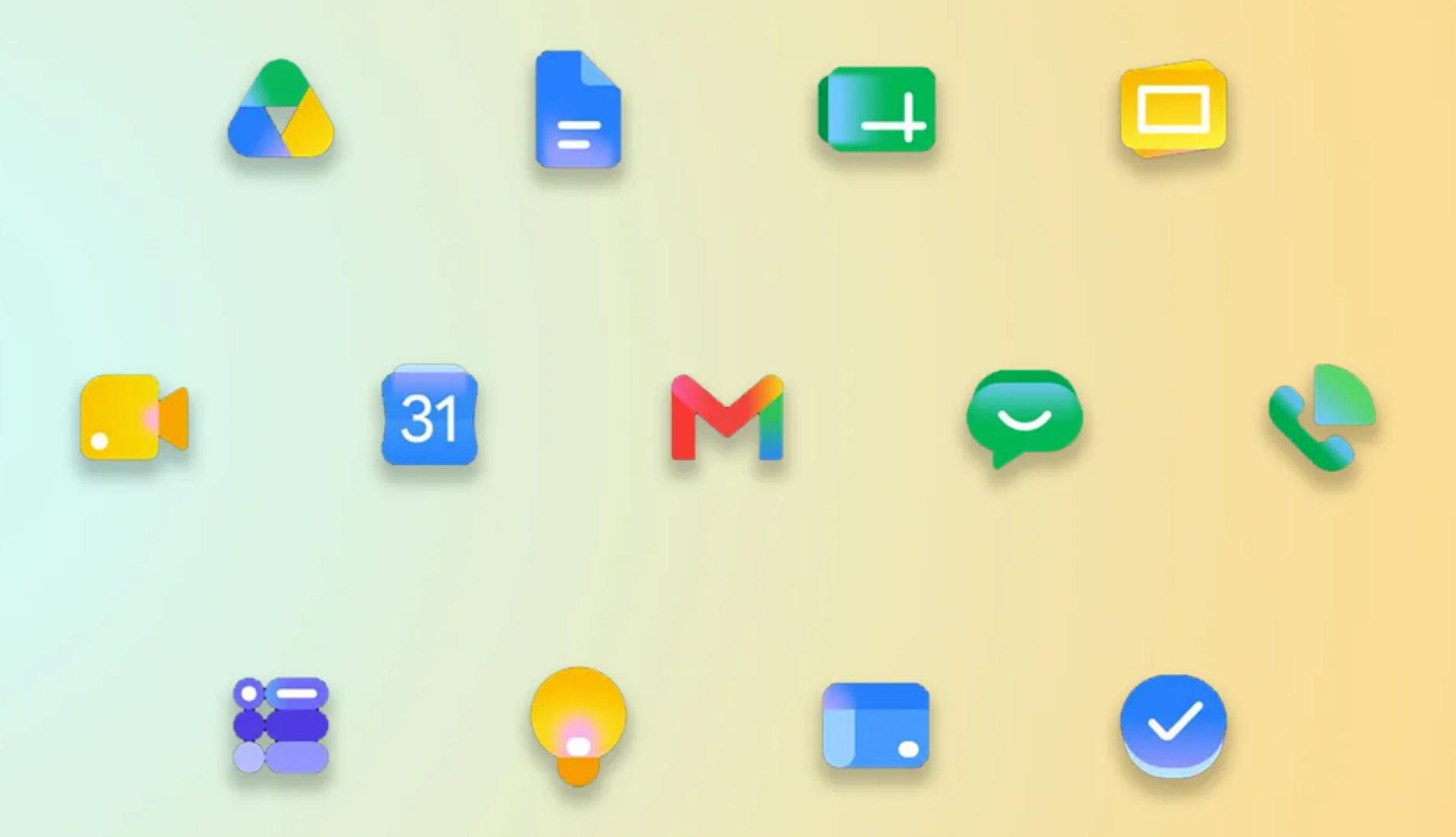
Google has begun to roll out a redesign of the icons of its main Workspace tools, including Gmail, Google Drive, Google Docs, Google Meet or Google Chat. The update, which began to appear on May 18 on the web, Android and iOS, subtly but significantly modifies the visual identity of some of the most used applications in the digital ecosystem.
The most obvious change is in the chromatic treatment. The new icons partially abandon the flat design and the flat color surfaces that had dominated over the last decade to adopt soft gradients, diffuse chromatic transitions and a more organic and bright appearance. Gmail, for example, now integrates a continuous transition between Google’s corporate colors and green; while Google Docs incorporates purple hues over its traditional blue. Meet and Chat, for their part, simplify their palette and begin to rely on more atmospheric schemes.
This is the first major visual update of the Workspace icons since 2020 and would respond to Google’s desire to visually reflect its definitive entry into the era of artificial intelligence. Beyond functionality, the redesign seeks to align the product interface with the new aesthetic codes associated with generative AI.
The evolution also connects with a visual trend that has accelerated since the emergence of ChatGPT at the end of 2022. Faced with the rigid and geometric minimalism that dominated digital design for years, technology companies are increasingly turning to gradients, lighting effects and less defined shapes to represent complex, abstract and difficult to visualize technologies. This boom has been defined as the aesthetic “AI gradient everywhere”.
The movement does not only affect Google. In recent months, several recurring graphic resources have been consolidated among technology brands linked to AI. Among them, the minimalist circles used by Meta or Grok stand out; the sparkles and stars that appear in Gemini, Grammarly or Adobe; or the abstract shapes and organic spirals present in OpenAI, Anthropic or Perplexity.
In this context, the Workspace redesign also functions as an aesthetic and strategic statement. Google thus visually adapts one of its most recognizable ecosystems to the new technological story dominated by artificial intelligence.