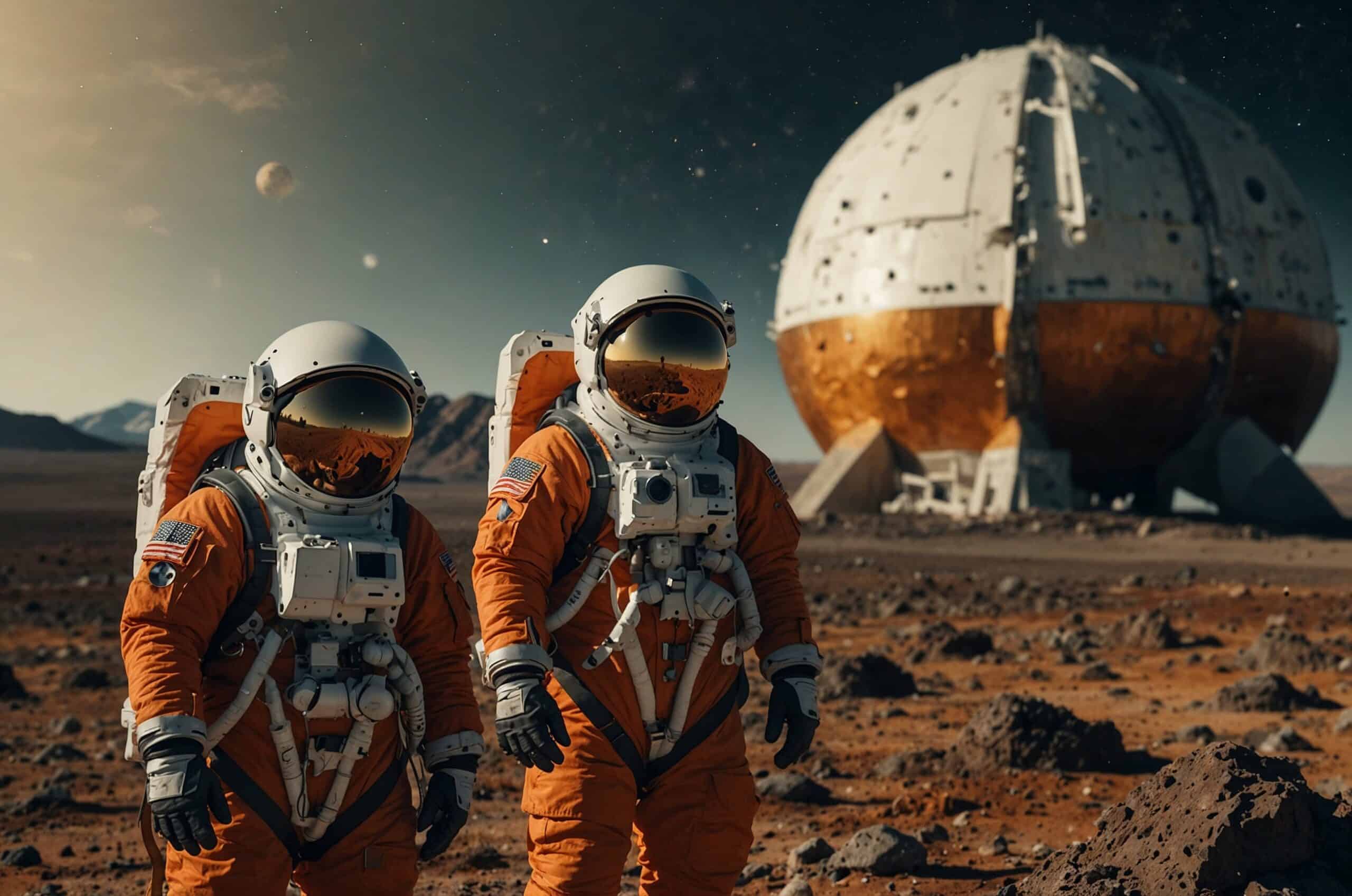
The possibility of settling humans on Mars has long fascinated people. Advances in robotic exploration, aerospace and life sciences are making the idea increasingly tangible, but transforming Mars into a habitable place involves considerable scientific, technological, medical and ethical challenges. This article examines the main obstacles and the solutions envisaged.
A hostile environment
Mars has extreme conditions: a very thin atmosphere composed mainly of carbon dioxide, an average pressure of around 0.6% of that of Earth and often very low temperatures (often well below −60 °C). The absence of a global magnetic field and a dense atmosphere exposes the surface to significantly higher cosmic and solar radiation. It will therefore be necessary to have airtight habitats, efficient life support systems and protection against radiation, possibly through buried habitats or covered with regolith.
Resources: water, air and food
The logistics of a Martian colony will depend heavily on the exploitation of local resources (ISRU — In‑Situ Resource Utilization). Water, in the form of ice in the polar ice caps or underground, is crucial for consumption, oxygen production and fuel manufacturing. Chemical processes such as the Sabatier reaction convert atmospheric CO2 into methane (fuel) and water, using hydrogen imported or extracted locally. For food, controlled greenhouses and hydroponic or aeroponic systems are considered; experiments on Earth show that it is possible to cultivate various plants in simulated soils, provided that suitable nutrients, water and climatic conditions are provided.
Health and physiological effects
Long duration flights and living in low gravity pose serious health risks. In microgravity, muscle atrophy, bone loss, cardiovascular alterations and neurovestibular effects are observed. Mars offers a gravity about 38% that of Earth; the impacts of a prolonged stay at this partial gravity remain poorly understood. Radiation increases the risk of cancer, cardiovascular disease and neurological disorders. Countermeasures such as intensive exercise, pharmacology, protective materials and construction of buried habitats are necessary, but require extensive research and testing.
Energy and autonomy
A viable colony must be largely self-sufficient in energy and maintenance. Solar power is an obvious option but dependent on sunlight and subject to dust accumulation. Small nuclear reactors offer a stable and compact source of energy. Air and water recycling systems, inspired by the International Space Station, will need to be more robust and redundant. Local capacity to repair, manufacture and recycle parts and consumables will be critical to long-term survival.
Technologies and initiation missions
Robotic missions (rovers, landers) have already mapped, analyzed and taken samples on Mars, providing essential data. Next steps include demonstrations of ISRUs, modular habitat systems and heavy-lift landing tests. Public agencies and private companies are planning manned missions over the coming decades, but establishing a sustainable colony will require multiple successive missions and a substantial financial cost.
Ethical, legal and societal issues
Beyond the technical, the colonization of Mars raises ethical and legal questions: should we exploit another planet before having solved terrestrial problems? How to avoid biological contamination of a possible Martian environment? The space treaty must be adapted to regulate the exploitation of resources, ownership and responsibility. Choices about who leaves, with what goals, and under what conditions will have profound social implications.
Living on Mars is theoretically possible but remains extremely difficult. Recent advances make the prospect plausible on a scale of several decades, provided that we invest massively in research, develop ISRU technologies, ensure protection against radiation and understand the effects of partial gravity on human health. Mars could become a laboratory for learning to live off Earth, and perhaps a new frontier for humanity, but many technical, medical and ethical obstacles still need to be overcome before thriving colonies can be seen there.