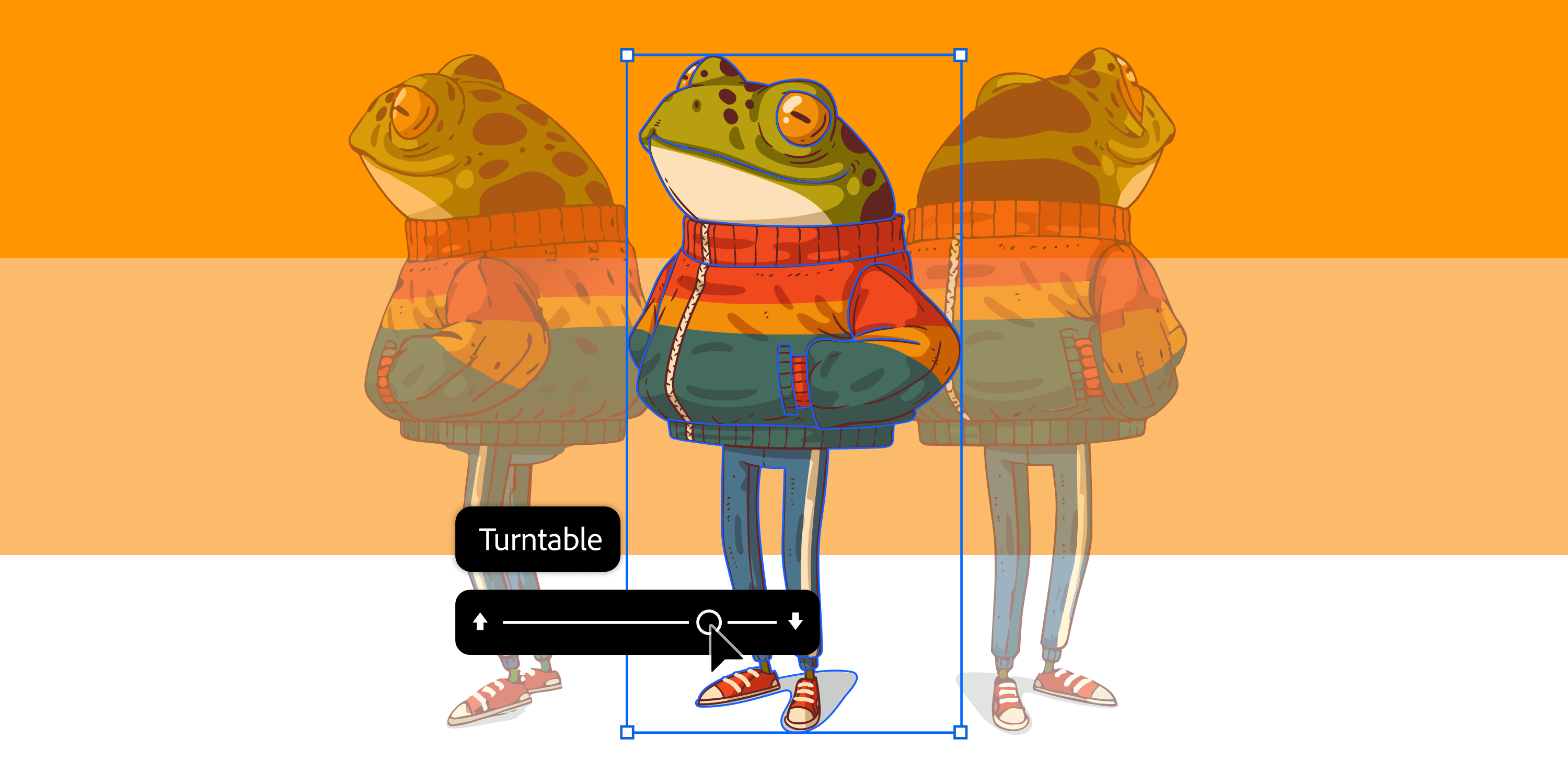
Adobe has added “Turntable” to Adobe Illustrator, a new feature that allows you to automatically generate views from multiple angles from a 2D illustration. The tool, which was previewed at Adobe MAX and has been refined with input from the creative community, responds to one of the historical frictions of design: the need to manually redraw characters or objects to simulate volume, rotation or movement.
Powered by Adobe Firefly, “Turntable” allows you to laterally rotate an object up to 180 degrees, generate vertical tilts and explore different perspectives from the same vector base. The system creates a set of linked views that can be viewed, extracted, or exported as animated sequences, turning a process that previously required hours of work into a virtually instantaneous operation.
The functionality is intended to expand the reach of Illustrator beyond static design. Animation teams can quickly generate character turns for presentations or storyboards; video game developers can create 360º visual resources to concept art; and social media teams can produce GIFs or micro-animations without leaving the design environment.
In addition, the integration with Adobe After Effects will allow these resources to be transferred directly to the field of the movementfacilitating fluid continuity between disciplines that have traditionally operated in separate tools. This interoperability reinforces Adobe’s positioning towards more integrated workflows, where creation, iteration and animation coexist in the same ecosystem.
And the launch of “Turntable” is part of Adobe’s broader strategy to incorporate generative capabilities into its creative tools. Along with other features such as generative shape filling or performance improvements, the company seeks to reduce execution times and expand the space for creative exploration.
Beyond operational efficiency, the tool introduces a relevant change in the creative process: it shifts the focus from technical execution to decision making. By eliminating the need to redraw multiple versions of the same object, designers can focus on conceptualization, visual storytelling, and formal experimentation.
With this, Illustrator evolves towards an environment closer to the logic of motion design and generative creation, offering speed, versatility and the ability to adapt to multiple formats.