There is an image that has been recurring to me in recent months. I participate in an event about generative AI – as an attendee, speaker or collaborating in the organization – and I meet people I haven’t seen in years. I’m not talking about recent contacts or profiles that have now appeared in the heat of the trend. I’m talking about designers, art directors, creatives, strategists, teachers, hybrid profiles, people of my generation with whom I shared decisive conversations more than twenty years ago, when the Internet was not yet an accepted medium but a promise under construction.
And every time it happens I think the same thing: something important has been activated again.
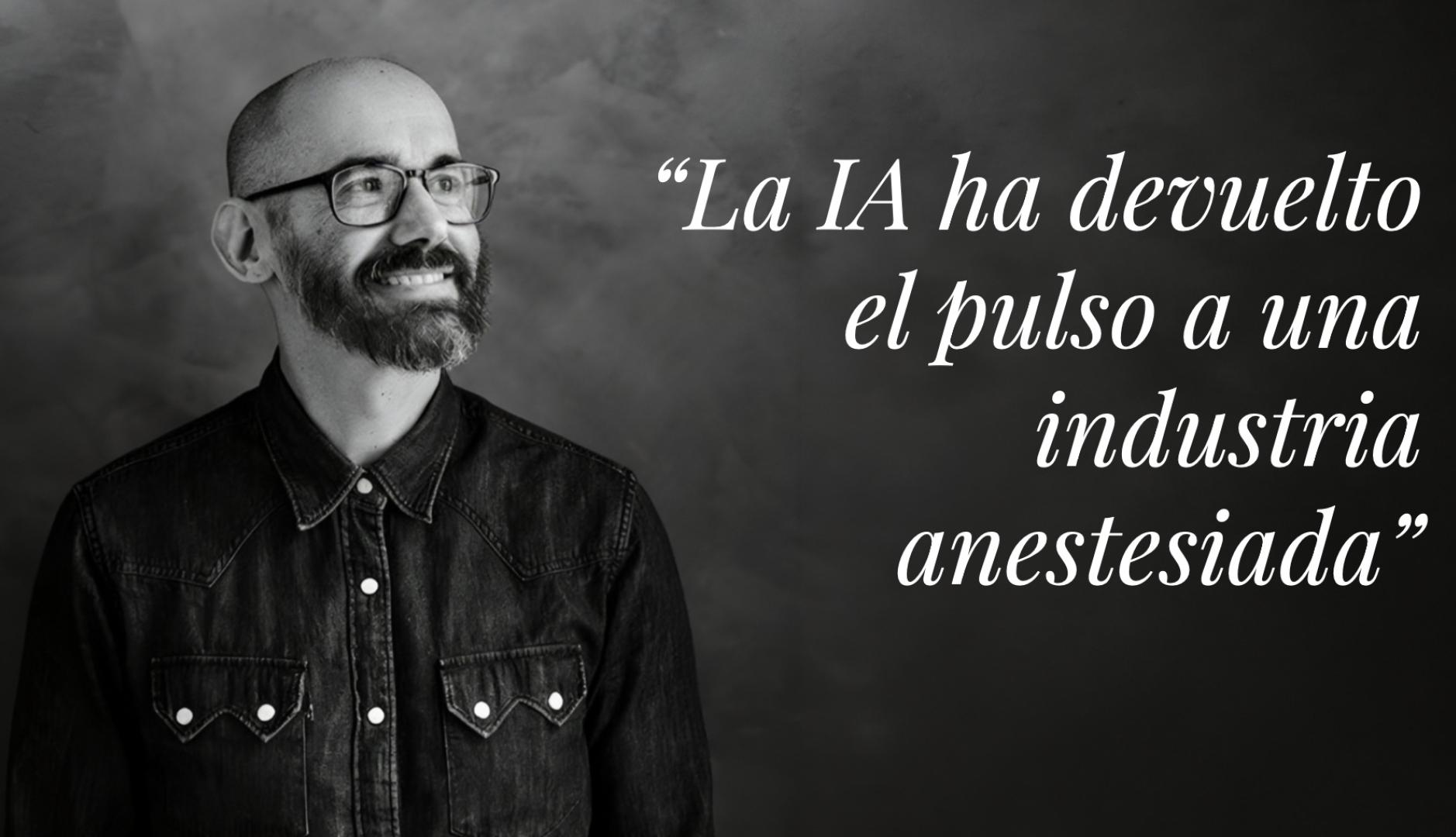
It’s not nostalgia. It’s not a veterans’ meeting (ahem). It is not a generational coincidence. It is the symptom that AI has not only emerged as a technology, but as a cultural trigger within an industry that had been installed in an unproductive comfort for too long. Or, to put it less diplomatically: in a certain anesthesia.
During recent years, the design sector – and in part also that of creativity in a broader sense – has experienced an uncomfortable paradox. There have never been so many refined processes, so many consolidated methodologies, so many mature systems, so much operational capacity. And at the same time, a real shake hadn’t appeared in a long time. Lots of sophistication. Lots of efficiency. Lots of framework. But little chicha.
Yes, tools have changed, flows have improved and we have gained collaboration, speed and consistency. But we should be honest: the great recent revolution in design was, to a large extent, moving from platforms to Figma. And while Figma clearly transformed the way teams work, it also didn’t reopen the essential questions of the trade. He improved the mechanics, not the frame. AI, on the other hand, is touching a nerve.
Because it does not fit as another tool into the usual stack. It enters by altering the logic of access to capabilities that, until very recently, were linked to specific training, hours of practice and technical mastery. Today, generating images, prototypes, texts, concepts or visual variations is within the reach of many more people. The barrier to entry has collapsed. And that, inevitably, forces us to relocate the value.
This is where one of the most interesting paradoxes of this moment appears: the generational one.
For years we assumed that any technological change would be led by the youngest. It seemed like a natural law of the digital ecosystem: the less attachment to the previous model, the greater the speed of adoption of the next one. However, with AI the photo is much more complex. Because in many of these spaces what I am seeing is not only young generations exploring with ease, something logical and expected, but many deeply activated senior professionals.
And no, I’m not talking about a desperate reaction to not be left out. I’m not just talking about the fear of losing relevance or employment, although that fear exists and it would be naive to deny it. I’m talking about something else: illusion.
A recognizable illusion for those of us who have already experienced another moment of wild acceleration. Because what we breathe now is less reminiscent of a conventional technological update and more of the early years of the Internet, when every few weeks a new tool, a new language, a new promise appeared. There was vertigo, of course. But above all there was desire. Want to try. Want to touch. Desire to understand. Desire to arrive earlier not to dominate, but to discover.
That’s exactly what I’m seeing again in many people of my generation. Not a resigned resistance. Not forced recycling. But a reactivation of hunger. And that word matters: hunger.
Because if something has been missing in much of contemporary design, it has been precisely that. Hunger for exploration, hunger for risk, hunger to reformulate the field beyond incremental improvements. Design has gained a lot in professionalism, but sometimes at the cost of losing friction. It has become more robust, more measurable, more integrated, more strategic. All of that was necessary. But in the process a part of its experimental energy has also been domesticated. AI has come to break that domestication.
Not because it brings answers, but because it brings questions again. And an industry is only truly alive when the important questions are circulating again. What does it mean to create when producing becomes radically cheaper? What value does authorship have when generation accelerates? Where is the singularity when access to execution is democratized? What does a creative professional contribute today beyond the instrumental domain? What are we really teaching when we teach design, advertising or art direction?
In my opinion, this is the central conversation. Not whether a tool generates an image better or worse. Not if a workflow saves more or less time. Not if a specific task is going to disappear before another. All that matters, yes, but it’s on the surface. The substantive discussion is based on criteria. AI democratizes access to production, but it does not automatically democratize judgment. And that difference will make the next decade.
Because when almost anyone can generate something visually competent, the decisive thing is no longer just doing, but deciding. Decide what deserves to be done. Decide what makes sense culturally. Decide what tone corresponds to each context. Decide which references enrich and which only decorate. Decide when an image works and when it just looks like it works. Decide what question is worth asking before rushing towards an answer.
That is the blind spot of much current enthusiasm: confusing production capacity with vision capacity.
And here it is important to be clear. Defending the criterion does not mean raising an elitist barrier against democratization. On the contrary. That more people can access tools previously reserved for specialists is, in many ways, excellent news. It expands the field, opens up possibilities, allows new voices to appear and dismantles certain technical monopolies. But precisely for this reason the criterion becomes more important, not less.
That is why I believe that the most urgent question is not technological, but educational. How are we preparing creative talent for a scenario where tools change faster than teaching programs, agency organizational charts, or traditional specialization frameworks? What does it mean today to train a designer, a creative, an art director, a visual strategist?
If we continue educating as if the differential were mainly in mastering interfaces, we will be late. Because the interfaces change. They are simplified. They integrate. They are automated. What is not improvised with the same ease is critical thinking, visual culture, sensitivity, the ability to read contextually, the construction of criteria, the ethics of creative decisions or the ability to ask good questions. Therein lies the real challenge.
Training for this moment requires much more than adding an AI subject to a degree or a master’s degree. It requires reviewing what we understand by creative excellence. It requires assuming that talent will no longer be measured only by execution skill, but by the depth of vision. It requires shifting the focus from the tool to the intention. From skill to meaning. From output to interpretation capacity. And that has direct implications for the entire industry.
That is why it seems significant to me to connect this conversation with the context of the c of c. Because beyond the agenda, the awards or the pieces, what is perceived in these types of spaces is that the industry is going through a fundamental transition. We are not simply adjusting processes. We are renegotiating value, reviewing hierarchies. And we are rethinking what we consider a craft, what we understand by idea, what place experience occupies and how creativity is reconfigured when production stops being the main bottleneck.
And like any transition, this one also comes loaded with contradictions. There is fascination and there is fatigue. There is also a lot of opportunism (we see it daily on LinkedIn). There are profiles that embrace AI as if it were a religion and profiles that reject it as if that refusal could stop the change. In the midst of that noise, what is relevant is not to position yourself for or against as if this were a binary moral dispute. The important thing is to refine the conversation.
Because the question is not whether or not AI enters the creative industry. He has already entered. The question is what kind of industry we want to build from here.
One that uses these tools only to produce faster, cheaper and in a more undifferentiated way. Or one that takes advantage of this shock to recover ambition, complexity and intellectual demand. One that replaces criteria with automatism. Or one that understands, precisely now, that the criterion is the last great non-automatable differential.
What interests me most about this moment is that it has returned the pulse. It has brought back people who seemed disconnected from certain circuits because they no longer found a truly stimulating conversation in them. It has restored curiosity to spaces that had become excessively predictable. It has broken an inertia. It has forced you to come off autopilot. And that, in an industry that ran the risk of becoming confused with its own operations, is already a lot.
I don’t know if we are facing a revolution equivalent to the arrival of the internet. Maybe we still don’t have enough distance to say it. But I do know that it’s been a while since I’ve seen this mix of interest, energy, discomfort, and desire. And that mix is usually a reliable signal: it indicates that something is not only changing, but deserves serious discussion.
Maybe that’s why these events seem, in some ways, like a time machine. Not because they return us to the past, but because they remind us of a sensation that we thought was lost: that of entering a new territory without a definitive map. The difference is that now we arrive with more experience, more memory and, hopefully, also with better judgment.
At a time when almost everything seems to have been democratized, accelerated and automated, what once again separates the relevant from the irrelevant is not the tool. It’s the look.
AUTHOR: Wences Sanz, Creative Experiential Director at Freepik