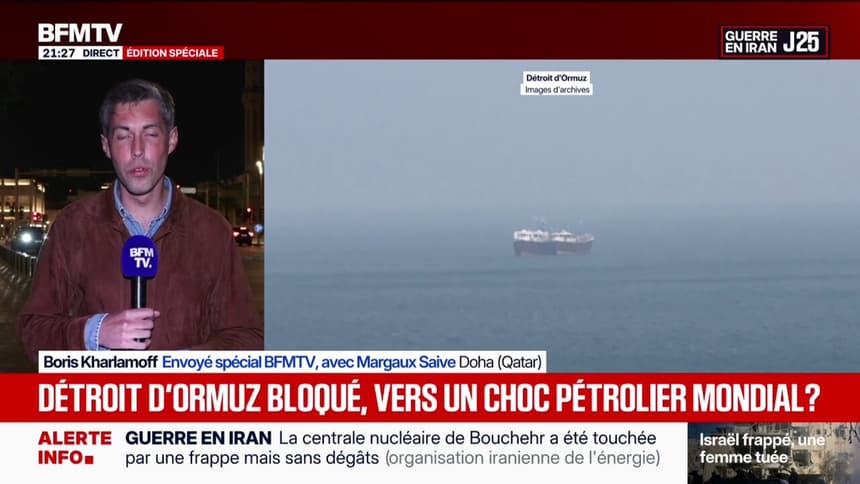
The Minister of the Economy, Roland Lescure, announced that the war in Iran, which has lasted for 26 days, is causing a “new oil shock” in France. This war has very concrete consequences in our country, with sharp price increases.
A sudden rise in the price of oil
An oil shock refers above all to a sudden and significant increase in the price of oilwith negative consequences on the global economy. This phenomenon usually occurs when oil supply decreases or that demand increases sharply. Result: prices skyrocket in a very short time.
The causes can be multiple, but they are often linked to geopolitical tensionssuch as armed conflicts or crises in producing countries. The current situation at Middle East is a concrete illustration of this: this region concentrates a large part of the world’s oil reservesand any instability can disrupt supply.
Concretely, as oil remains an essential resource (transport, industry, energy), any disturbance in its price has chain effects across the entire economy.
Why do we talk about “shock”?
The term “shock” is not used randomly. It refers to the idea of a sudden and unexpected impact on the economy. We talk about “supply shock” when the production of a resource suddenly decreases. In the case of oil, this means that producing countries reduce their production or that supply is disrupted.
This situation immediately causes several effects such as rising production costs for businesses, a price increase for consumers and therefore a decline in purchasing power.
Major economic consequences
Among the biggest price increases, we find the fuel oilTHE fish (due to the increase in the price of diesel for fishermen) and plane tickets. Since the start of the war Middle Eastprices change from one day to the next. For fuel oil, the price can rise by 10 to 15 € in the same day. With some suppliers, it now reaches around €1,750 the 1,000 liters, against €1,250 before the conflict.
Electricity is also expected to increase from May.
THE plane tickets have also been more expensive since mid-March. Some companies are increasing their prices to take into account the increase in kerosene. For example, at Air France, prices are increasing by €10 for short and medium hauls, €50 for long hauls, and up to €70 for destinations like Mexico, the United States or Canada.
THE fish is also affected. With too expensive fuel, fishermen must face additional costs of up to €2,500 per week. In these conditions, some boats prefer to stay at the dock. Result: on certain stalls, fish prices increase up to €4 more per kilo.
An energy crisis taking hold?
The Minister of the Economy, Roland Lescuredescribed the current situation as a real “oil shock”, recalling that the world has experienced “around ten in the last 50 years”. Heard on March 24 before the Finance Committee of the National Assemblyhe estimated that the hypothesis of a temporary crisis was now receding, emphasizing that its effects could be long-lasting.
He notably highlighted the scale of the phenomenon: between 15 and 20% of global oil and around 20% of liquefied natural gas no longer reaches the markets, i.e. almost 11 million barrels per day less. According to him, if this energy shock continues beyond a few weeks, it could “spread more widely throughout the economy” and take on a more systemic dimension.
The minister, however, qualified by specifying that France remains less exposed than some of its European neighbors, in particular thanks to a lesser dependence on gas for the production of electricity, largely provided by nuclear power and renewable energies.