The fact is difficult to ignore: between 34% and 50% of young people wish that some of the main social networks had never existed. It is one of the multiple indicators collected by the World Happiness Report to support the forceful conclusion that the regular use of these platforms cannot be considered safe for children and adolescents.
This publication, published annually by the UN, classifies more than 140 countries by their level of happiness and well-being. It uses Gallup polls where citizens rate their lives, based on key factors such as GDP per capita, social support, life expectancy, freedom, generosity and low corruption. This year’s report addresses the issue of networks from what it calls the “product safety question”: whether the ordinary use of social networks – understood as several hours a day – exposes minors to significant risks to their mental health or direct harm. Based on seven independent lines of evidence, including surveys of young people, testimonies from parents and teachers, academic studies and internal documents from the companies themselves, the answer offered is clear: no.
The analysis becomes especially relevant if the level of exposure is taken into account. An average teenager in the United States spends about five hours a day on social networks (two on YouTube, an hour and a half on TikTok and another on Instagram), while one in four young people between 13 and 14 years old exceeds seven hours a day.
34% wish Instagram did not exist
From intensive use to regret
One of the pillars of the report is the testimony of the young people themselves. Far from the usual narrative that presents social networks as spaces of connection and creativity, the data reflect a much more ambivalent relationship, in which benefits coexist with a growing perception of harm.
According to data from the Pew Research Center, 20% of adolescent girls say that social networks negatively affect their confidence, 25% their mental health, and 50% their quality of sleep. Furthermore, 34% of girls and 20% of boys acknowledge that they make them feel worse about their own life.
However, the most telling indicator is regret. In a survey carried out among young adults of Generation Z (18-27 years old) in the United States, the rejection of certain platforms reaches significant levels: 34% wish Instagram did not exist, 43% think the same about Snapchat and almost half express it regarding TikTok (47%) and X (50%). In contrast, this regret is much lower on platforms like YouTube (15%) or services like Netflix (17%).
This pattern is repeated in other countries. In the United Kingdom, 62% of young people consider that social networks do more harm than good to those under 16 years of age, and 55% say that life would be better if they were banned for that age group. In Australia, young people themselves identify these platforms as one of the main factors behind the deterioration of mental health.
Hence, precisely, countries like Australia have chosen to restrict access to minors under 16 years of age, while European countries such as the United Kingdom, Spain and France have considered similar measures. Meanwhile, the United States has taken a different approach by pushing for age verification in app stores. The central argument is that the cost of not acting can be significantly greater than that of intervening. And, although many users recognize benefits such as feeling more connected (74%) or finding spaces for expression (63%), the UN report highlights that the key question is whether a significant proportion of users experience harm. And the evidence indicates yes.
This reading is finding, in parallel, an echo within the platforms themselves. The CEO of Pinterest, Bill Ready, has publicly defended these days Australia’s decision to prohibit access to social networks for minors under 16 years of age and has stated that, if the platforms do not truly prioritize youth safety, other governments should follow the same path. His argument is not limited to a regulatory issue, but rather points directly to the sector’s business model: he maintains that social networks, as designed today, maximize viewing time and retention with little regard for the well-being of minors. In response to those who consider these restrictions an exaggerated or premature response, the manager argues that the technology industry has already had enough time to self-regulate and that the absence of fundamental changes weakens any credible opposition to this type of veto.
The CEO of Pinterest warns of the added risk posed by the incorporation of AI chatbots to networks
The position is especially significant because it comes from one of the players in the digital ecosystem. In his approach, the question lies in whether the benefits justify the coexistence of social networks with constant pressures of comparison, unwanted contact with strangers, exposure to harmful content or dynamics of compulsive use. It also warns of the added risk posed by the incorporation of artificial intelligence chatbots into these experiences, by introducing even more persuasive tools in environments used by users who have not yet fully developed their emotional maturity. Their conclusion connects directly with the World Happiness Report: imperfect protection is still better than inaction, and postponing decisions in the name of the complexity of the problem can be equivalent, in practice, to protecting the status quo from platforms before teenagers.
Platforms designed to attract attention, not to protect
“Today’s young people are being victims of the greatest social experiment in history.”
The authors of the report place the phenomenon in a broader context: that of a social experiment on a global scale. For more than a decade, millions of minors have had unfiltered access to platforms designed to maximize usage time, with little initial consideration of their effects. The result, according to the analysis, is visible in multiple dimensions: increased anxiety and depression, deterioration in the ability to concentrate, and educational environments that constantly compete for students’ attention. Added to this is exposure to direct risks: cyberbullying, sextortion, violent content or contact with strangers.
The figures illustrate the magnitude of the phenomenon. In the United States alone, where it is estimated that there are 39 million adolescent users of social networks, around 10% present problematic use behaviors. 45% say that these platforms negatively affect their sleep, and millions of minors are exposed every year to situations such as harassment or unwanted sexual advances. In the case of Instagram, 13% of users between 13 and 15 years old report having received unsolicited sexual proposals in the last week.
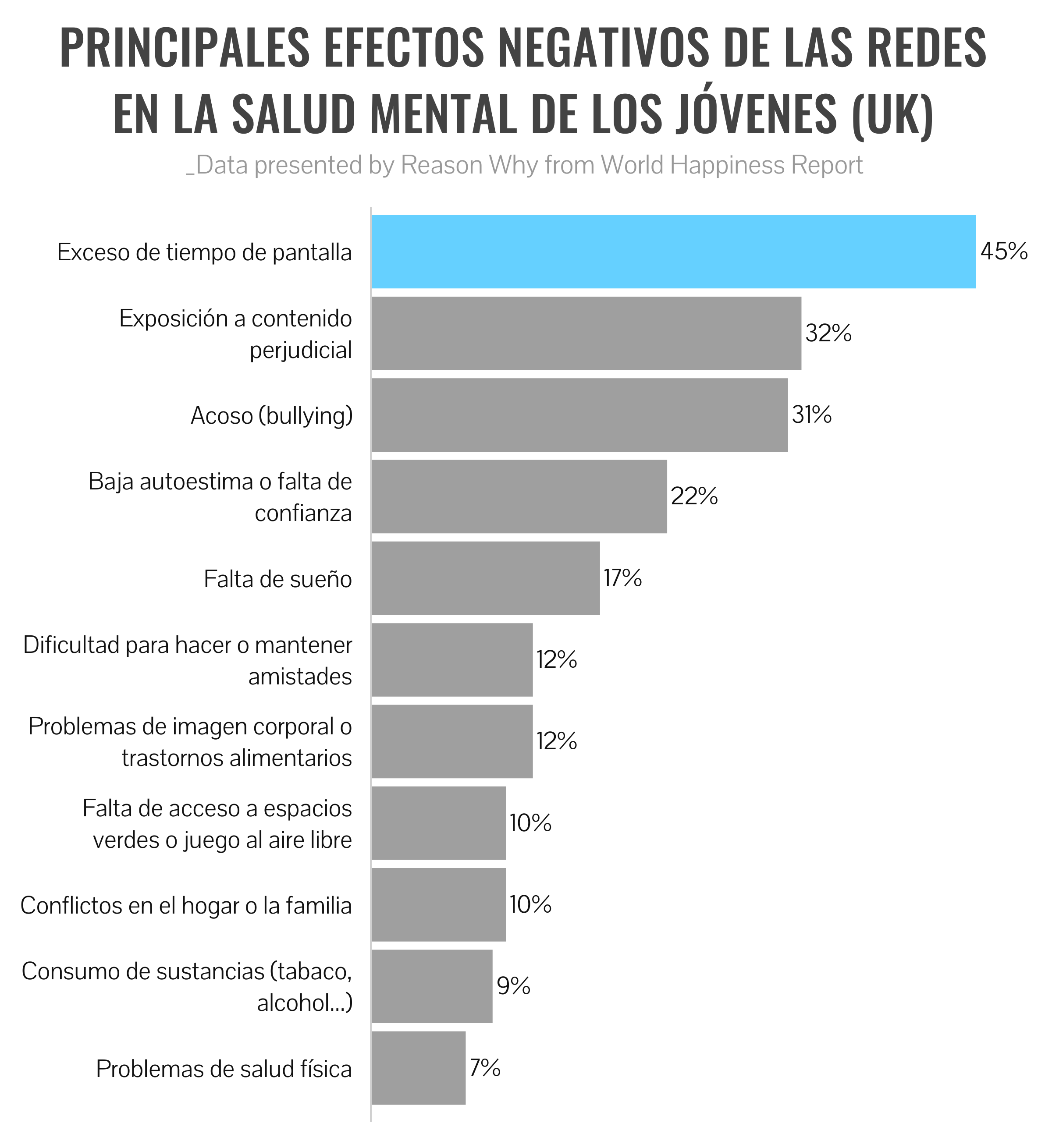
Added to this evidence are the technology companies’ own internal documents. Leaked research from Meta revealed that one in three teens say Instagram worsens their body image. At TikTok, internal reports recognize that compulsive use is linked to loss of cognitive skills, increased anxiety and sleep disturbances. And at Snapchat, company employees have admitted to receiving thousands of reports per month related to sextortion.
The report suggests that these dynamics are the direct consequence of design decisions aimed at maximizing retention. Intermittent reward systems, recommendation algorithms and social validation dynamics that generate usage patterns that, according to the developers themselves, exploit psychological vulnerabilities, especially in minors. So, beyond perceptions and testimonies, the report dedicates a central part to reviewing whether there is a causal relationship between the use of social networks and the deterioration of mental health.
In trials where the use of social networks is reduced for several weeks, improvements in depression and anxiety are observed
Cross-sectional studies consistently show that heavy users have higher levels of depression. An analysis of more than 10,000 adolescents in the United Kingdom concludes that those who use social networks more than five hours a day are twice as likely to suffer from depression than those who use them less than an hour. Additionally, each additional hour of use increases the risk by 13%.
While longitudinal studies reinforce this relationship by demonstrating that intensive use precedes the development of depressive symptoms, and not only the other way around. That is to say, not only do young people with poorer mental health use networks more, but intensive use contributes to worsening their condition.
For their part, controlled experiments offer one of the clearest evidence. In trials where social media use is reduced for several weeks, significant improvements in depression, anxiety and general well-being are observed. In a study with vulnerable youth, limiting use to one hour daily for three weeks reduced depressive symptoms, improved sleep, and decreased fear of missing out (FOMO).
Finally, so-called “natural experiments” – such as the expansion of high-speed internet – show that increased access to social networks is associated with worsening mental health in different countries, including Germany, Italy, Spain and the United States. These effects are especially pronounced in adolescents and, within this group, in girls.
The report concludes that the accumulated evidence, from multiple methodologies, countries and sources, is sufficient to affirm that social networks, in their current configuration, pose a risk to the mental health of adolescents.
In the implicit words of the report, the question is to what extent societies are willing to accept these effects as part of the current model.