
Although its essence and mechanisms have remained practically intact for decades, email marketing is the basis of communication and sales strategies. Email has gone from a simple mass messaging tool to a critical infrastructure for customer relationship management, marketing automation, and intelligent first-party data activation.
Professionals and brands move in an ecosystem where attention has become a scarce commodity and changes in platform algorithms make it difficult to impact the audience. Faced with the volatility of social networks, messaging services or artificial intelligence, email marketing stands out as one of the few channels that still provides control over the message and its reach.
And although it is used as a commercial tool, consumers still feel it personal, which makes its management key, and at the same time, challenging, for business growth. It is from a phase as early as choosing the provider, and this implies that choosing the appropriate email marketing platform can make a difference in the development of the strategy.
Free plans provide interesting possibilities to deploy strategies and scale communication
Many providers offer trial periods and free plans that can be useful for all types of companies and professionals, but especially for those who are starting their activity or have limited resources. However, the fact that these are free plans does not mean that they do not provide interesting possibilities to deploy strategies and scale communication.
Mailrelay vs Mailjet, which is better?
Mailrelay and Mailjet are consolidated and popular options, and they offer this type of options, although with different positioning and capabilities which, in turn, are understood as two different ways of understanding the role of email within the digital ecosystem of brands. Paying attention to the sending capacity, the number of contacts allowed or access to advanced functionalities is crucial to choosing the infrastructure on which to build the relationship with the audience.
Thus, when analyzing both options, it can be seen that while Mailrelay presents the free plan as an instrument for recruitment and volume, Mailjet conceives it as a limited trial version designed to scale towards paid solutions. Thus, the first step will be to consider the strategic context of each organization, and subsequently, compare the products and services offered by each platform and determine how they adapt to the needs.
It should be noted that Mailrelay is a Spanish platform whose proposal is based on offering a robust email marketing solution at a reduced cost and with a solid free plan. Its proposal can be attractive and useful for small and medium-sized companies, digital media, freelance professionals or projects that manage large-volume databases without assuming high costs from the beginning.
Its free plan allows you to send tens of thousands of emails per month to thousands of subscribers, which is a higher capacity than other platforms offer. In this sense, Mailrelay’s proposal stands out in a segment where price is a decisive factor, and its free plan works as a powerful commercial argument to attract companies that need recurring communication with large audiences.
For its part, Mailjet is a solution originally developed in France and is part of the Sinch group. Unlike Mailrelay, its proposal is based on offering an email marketing platform more oriented towards technology companies and e-commerce, so it has a more transactional approach. Furthermore, its business logic is oriented towards increasing technological sophistication by levels.
Its free plan is more restrictive in volume, both in the number of emails it allows to send and in the number of contacts, which reduces its usefulness for projects with large databases. Although its technical architecture offers advantages, especially in terms of automation and integration, its pricing model is less accessible to small or emerging businesses.
Mailrelay or Mailjet in 2026
Focusing on the technical aspects, the free plans of both tools also find differences.
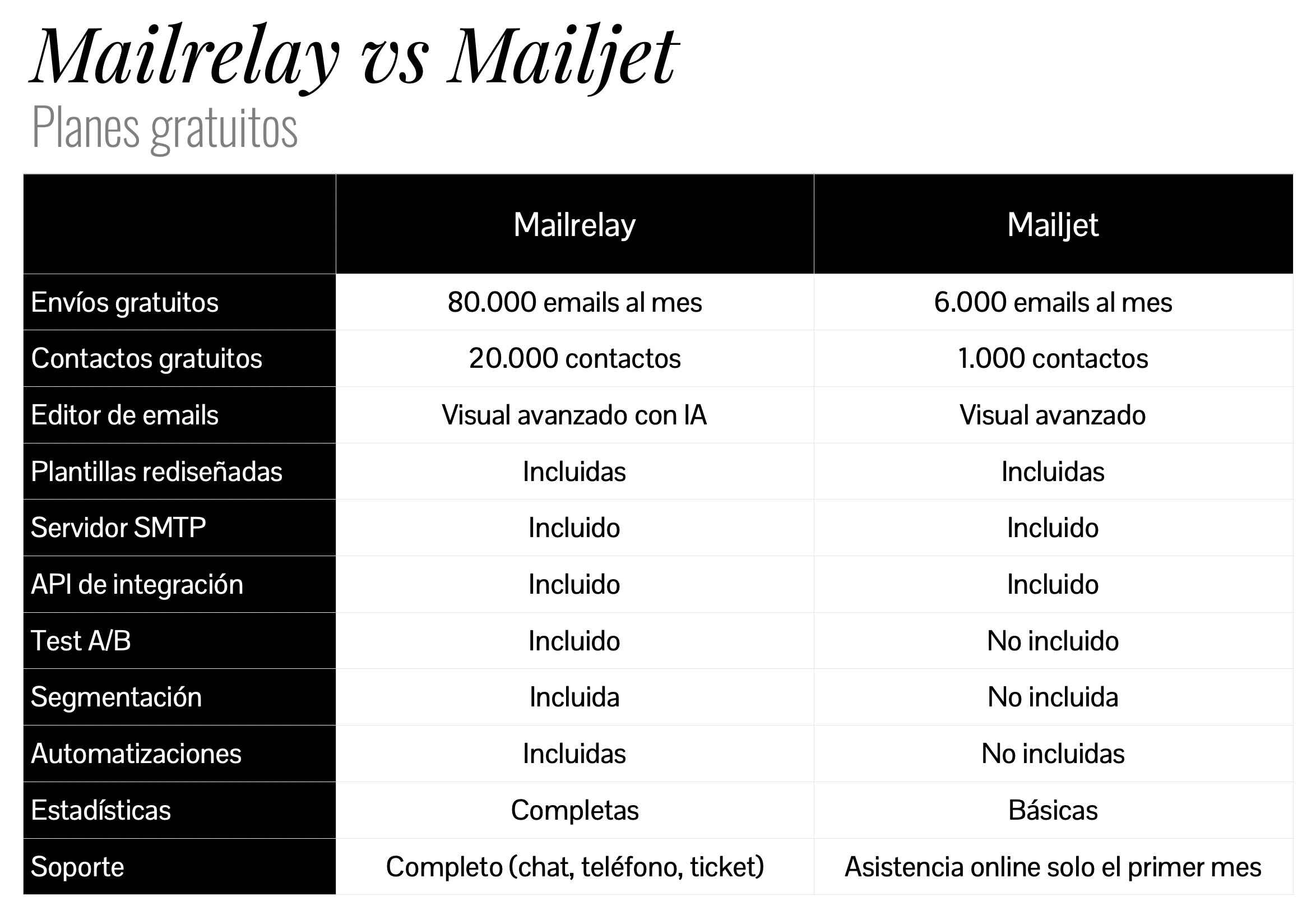
As reflected in the table, the most obvious advantage of Mailrelay’s free plan is its generosity in volume. The platform allows you to send up to 80,000 emails per month and manage a database of 20,000 contacts at no cost. The figures are significantly higher than those of Mailjet, which only allows 6,000 emails and 1,000 contacts in its free version.
Although both have an integration API and SMTP server – the protocol that allows email transfer -, Mailrelay provides segmentation options from the beginning in its free plan, and also allows A/B testing, something really useful to check, among other things, what type of messages and content work best among the audience.
Another point that differentiates Mailrelay from Mailjet is the email editor. Both offer an intuitive interface, pre-designed templates, and a visual editor made up of blocks and elements, but Mailrelay elevates the experience by bringing generative AI into the equation. Thus, users of this platform can create, compose and edit their emails through prompts and text indications.
With generative AI, users can create, compose and edit their emails through prompts and text indications
Mailrelay’s proposal also stands out in deliverability, having patented technology and algorithms that improve the delivery rate in mass shipments, no matter how voluminous they may be. This makes the platform a good option for companies with communication needs based on large volumes of emails. And although it is not part of the free plan, the company offers its own IP ranges that optimize arrival in the inbox and prevent emails from ending up in the spam folder, improving visibility.
Beyond technical aspects, one of the strong points of Mailrelay’s proposal compared to that of Mailjet and other email marketing platforms is its commitment to support and customer service. Instead of relying solely on a ticket model, its user help and assistance system is carried out through various means, including telephone contact and online chat, always assisted by a human team in Spanish.
In addition, Mailrelay also stands out in the statistics and metrics section. Where other services and platforms provide basic campaign performance information, such as opens, clicks and undelivered; Mailrelay offers more complete and real-time statistics, allowing greater knowledge of what works among the audience and facilitating optimization.
Although the choice between both platforms will depend on the needs and context of each organization, Mailrelay stands out as a solid, accessible and scalable option, especially for projects that seek to maximize sending volume with a minimal investment and relatively simple management. Instead, Mailjet may be better suited for businesses looking for technological sophistication.
Ultimately, the comparison between Mailrelay and Mailjet reflects that choosing a suitable platform for your business is more a matter of cost or functionality. It is a decision that must be adapted to the development of a company and the reality of current marketing, in which connecting data, technology and customer relations is a strategic point.