Managing social networks has become a role without clear boundaries, with normalized emergencies, constant pressure for performance and compensation that does not accompany the leap in complexity. The first “2026 Report on Wellbeing”, by Metricool, prepared from more than 1,000 responses from professionals around the world, puts figures on a wear and tear that is already impacting motivation, mental health and talent retention. 
The report is based on a broad snapshot of the sector: social media managers, community managers, content creators, marketing profiles and professionals who work on their own or lead their business. In this sample, very different structures coexist: from internal teams to agencies, to freelancers, but a common denominator appears: networking is experienced as a strategic function and, at the same time, as a permanent response service. The research thus places well-being as the “metric” that the industry tends to ignore, despite the fact that day-to-day life requires decisions, analysis, creativity and a long list of invisible tasks. 
75% say they feel like they have to do too many things at once
The first point to take into account is the definition of the role. The survey shows a multidisciplinary reality: strategy and planning, content creation, analytics, copywriting, graphic design and video editing appear as common responsibilities, often combined with community management, monitoring or crisis management. This expansion does not seem to be accompanied by equivalent operational limits: 75% say they feel that they have to do too many things at once, and a relevant part recognize that the load overwhelms them, at least on a recurring basis. The result is more work and more fragmented, with less mental continuity and a demand for constant change that makes it difficult to maintain judgment and consistency.
The second gap is time: 73% work outside of their working hours, something that is no longer exceptional but is integrated into the management of campaigns, launches, live events and, above all, last-minute changes. In fact, among those who have worked after hours, the main cause is precisely those emergencies: hasty changes, live coverage or some online crisis. The report thus outlines a routine that becomes unpredictable, an especially corrosive combination because it prevents planning rest and breaks the boundary between work and the rest of life.
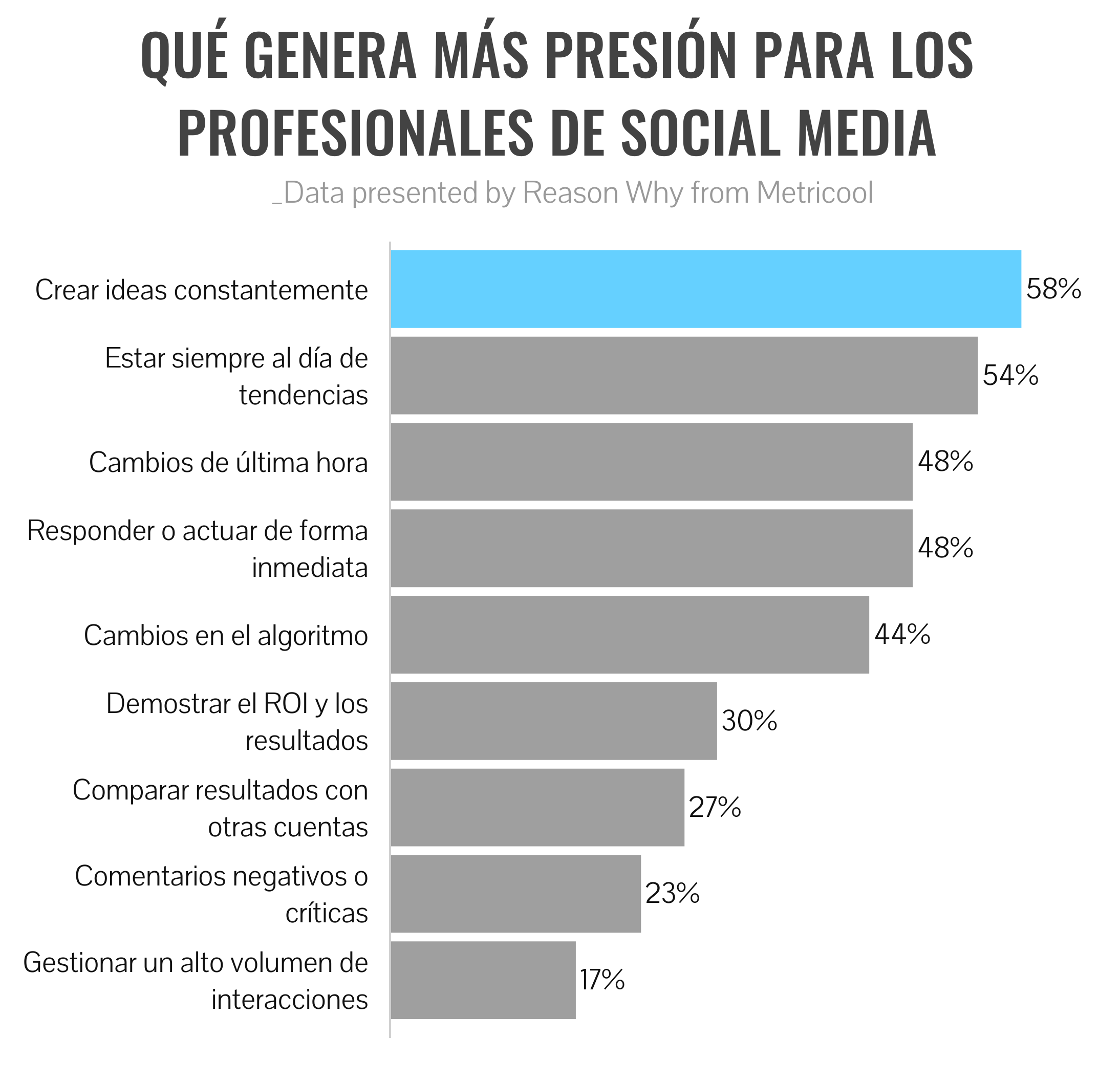
Added to this time pressure is psychological pressure: it is not enough to execute, you also have to perform “in the face” of metrics that are compared in public, deal with algorithms that constantly move and with audiences that demand an immediate response. Among the situations that generate the most tension appear, precisely, the need to constantly create new ideas, stay up to date without rest, manage urgent requests and demonstrate results. This climate materializes in concrete consequences: 73% declare loss of motivation or creativity, 69% mental fatigue, 62% difficulty disconnecting and 46% burnout or similar symptoms. And the blow also affects professional continuity: another 46% claim to have considered leaving their job due to stress, a fact that connects well-being with a business problem of talent retention and sustainability. 
In parallel, the report places an uncomfortable mirror before recognition. Although many professionals perceive creative freedom, that autonomy does not translate proportionally into rewards. In the last 12 months, only 24% claim to have received a financial improvement and only 15% a promotion or professional recognition. At the same time, the report states that a significant portion does not feel that their work is fairly rewarded, which feeds a classic tension in the social ecosystem: high exposure, high demand and a persistent perception of undervaluation compared to other marketing roles.
Technology then appears as a crutch, but not as a complete solution. 72% already use AI or automation tools to alleviate part of the burden, along with specific social media marketing tools, suggesting that efficiency is being sought more for survival than strategic optimization. The hierarchy of demands itself reinforces this: when asked what would change the most on a daily basis, the first place is occupied by improvements in processes and planning (37%), followed by new tools to improve efficiency (34%), and well behind real limits on working hours (14%). Even when the underlying problem is identified, the practical response is often formulated in an operational key: order, systems, tools, as if the sector assumed that the pressure will continue to be there and the urgent thing was, at least, to make it more manageable.