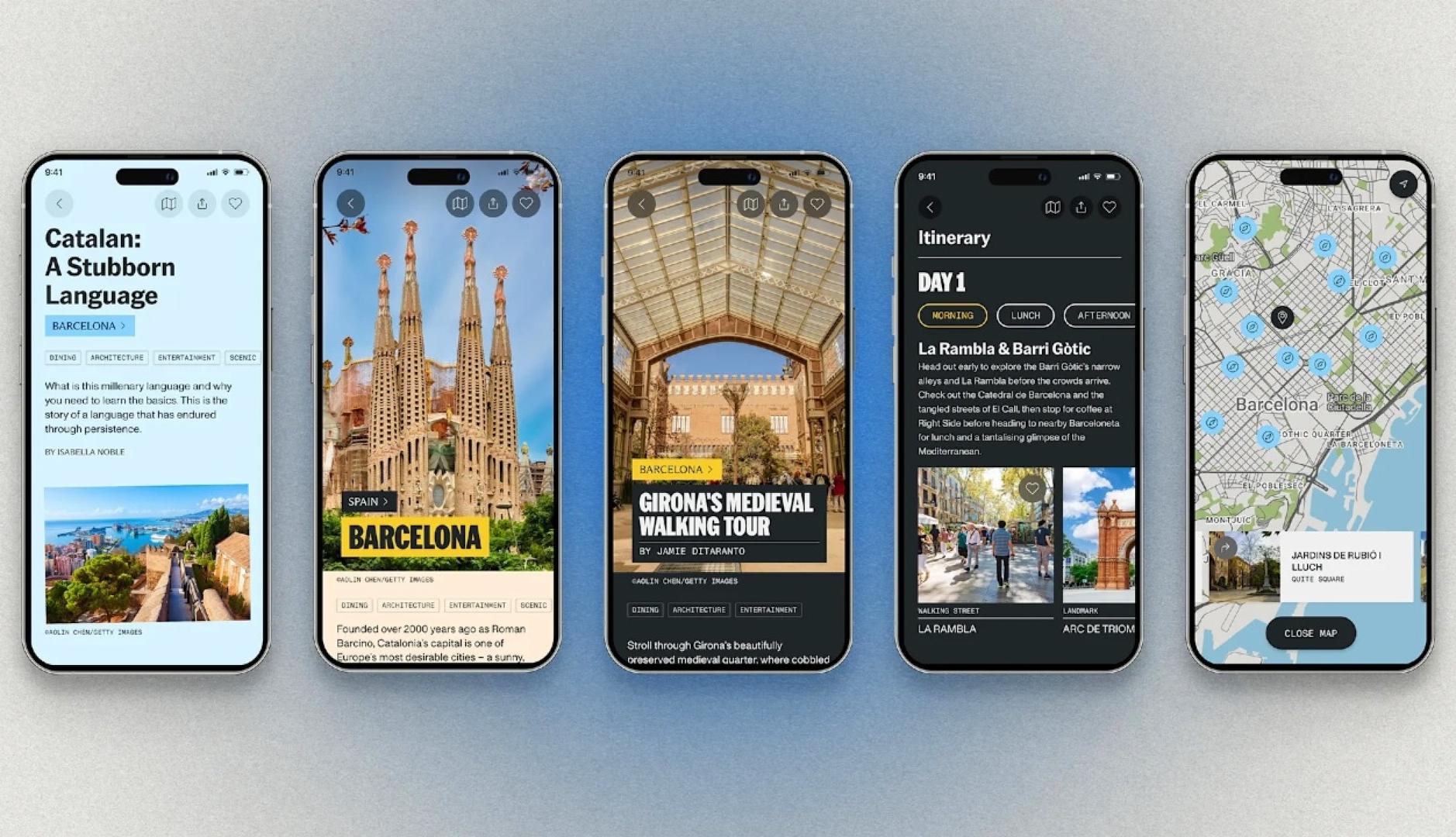
For more than five decades, Lonely Planet guides have accompanied generations of travelers looking for reliable recommendations outside the traditional tourist circuits. Now, the company takes a strategic step to adapt that legacy to the mobile environment with the launch of a new travel application that transfers the knowledge of its guides to digital format.
The app brings together editorial content developed by its network of more than 450 local writers and experts, but combines it with functionalities designed for trip planning and management. Thus, users can save places on maps, build personalized itineraries or find nearby recommendations in real time when they are already at their destination. Unlike many tourism platforms, the content is not based on massive user reviews or sponsored listings, but rather on editorial curation prepared by the same experts who write the guides.
The launch of the app marks a change in the company’s identity, which is beginning to define itself less as a publisher and more as a service platform for travelers. The brand was founded in 1973 by Tony and Maureen Wheeler with a travel guide to Asia geared toward backpackers. Over time, these publications, recognizable by their characteristic design, became one of the benchmarks of independent tourism.
Paul Yanover, CEO of Lonely Planet for a year, believes that the challenge is to transfer that cultural capital to the digital environment without losing its essence. “In a way we are trying to return Lonely Planet to what it always was at its best: not just a publisher, but a living guide that connects people to places”he explains.

In the last year, the company has prepared the ground for this transition with a brand redesign, a new website, the launch of Lonely Planet Journeys – a personalized travel service – and an expansion of its editorial catalog. The application is presented as the centerpiece of this entire process.
The application, specifically, organizes the experience into four main sections.
- Discover works as an inspiration engine with articles, videos and recommendations
- Guides offers digital versions of destination guides
- My Planet allows you to save places or content
- Trip Builder transforms that information into a customizable itinerary with an integrated map.
One of its key features is the destination mode, which adapts recommendations based on the traveler’s location to suggest nearby activities or resolve changes in plans during the trip.
The app will initially be free, while the company analyzes user behavior. In the medium term, the model will include paid premium content, such as complete guides or annual subscriptions that will give access to the entire digital catalog and additional benefits in other brand services.
Travel recommendations are increasingly generated through algorithms or social networks, which is why Lonely Planet wants to reinforce the value of its network of human experts. According to Yanover, this editorial approach is precisely what differentiates the brand in an ecosystem saturated with information.
The company is exploring, however, the use of artificial intelligence to facilitate access to that knowledge – for example, through an assistant trained with the content of its guides – while maintaining the editorial logic that has defined the brand since its origins.