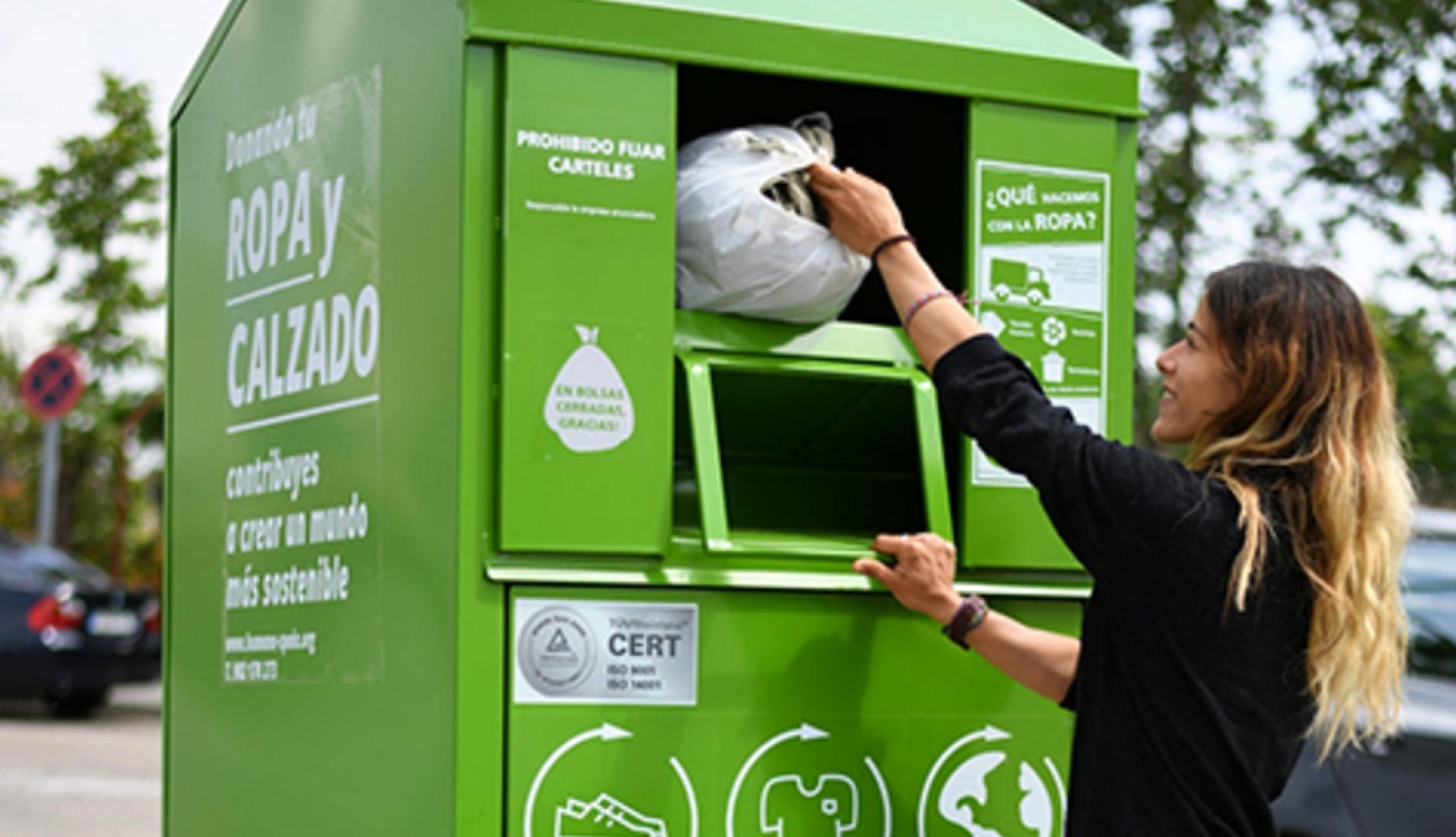
Humana Fundación Pueblo para Pueblo has joined TexMat, a European project that wants to bring the logic of “deposit and return” to textile waste: depositing used clothing on public roads, but with a technical and behavioral twist. The proposal involves installing automated containers that, in addition to collecting garments, are capable of pre-classifying them and evaluating their quality to guide their destination – reuse or recycling – and, at the same time, reward citizens when they deliver reusable or recyclable items. The initiative is funded by Horizon Europe and will run until March 2029 with pilots in Spain and Finland, under the leadership of the Finnish VTT center, together with a consortium of 14 partners from seven countries.
Sorting usually depends on labor-intensive processes and decisions made when the waste is already inside the circuit.
The movement is relevant in contrast to the system that has operated until now in a large part of the market: collection is supported by donation containers and the logistics of operators, town councils and social entities, but the bottleneck comes later. Sorting usually depends on labor-intensive processes and decisions made “after the fact,” when the waste is already inside the circuit. This model works – and has made it possible to build second-hand networks – but it scales with friction when volume grows and average quality drops. The European context itself is forcing a redefinition of the process: the amount of textile that ends up outside of separate collection continues to be high and fuels a landfill or incineration problem that the EU wants to reduce structurally. 
In this sense, TexMat proposes to intervene earlier, at the point of entry. In Spain, together with Humana, the Universidade da Coruña (research on sustainable business models, consumer studies and system requirements), IRIS Technology Solutions (digital solutions and software for collection and classification) and Rovimatica (development of the TexMat app and the smart container, with experience in software and AI) participate.
The ambition is that the container is not a simple “letterbox”: its integrated technology would help to pre-sort items, capture data on material properties and, where it exists, connect it with the future digital passport of the product to reconstruct the circularity path of each garment. In addition, the system contemplates notifying producers when there are rejected garments that require adequate management, in line with the logic of extended producer responsibility (EPR) that is gaining weight in the European regulatory framework. 
In the words of Ece Şanlı, circular economy expert at Humana, “As the EU redefines the future of textile sustainability, the recovery of used textiles has never been more urgent. TexMat directly contributes to the development of the future digital passport, while rewarding citizens for making responsible decisions and encouraging greater participation in a circular textile economy”. 
For her part, Elina Ilén, project coordinator at VTT, formulates it from the efficiency of the system: “This initiative has great potential to transform the collection and resale of used and still valuable parts, and allows consumers to monetize their donations”in addition to reducing dependence on manual labor by separating “quickly and accurately” what is reusable and what is intended for disposal.