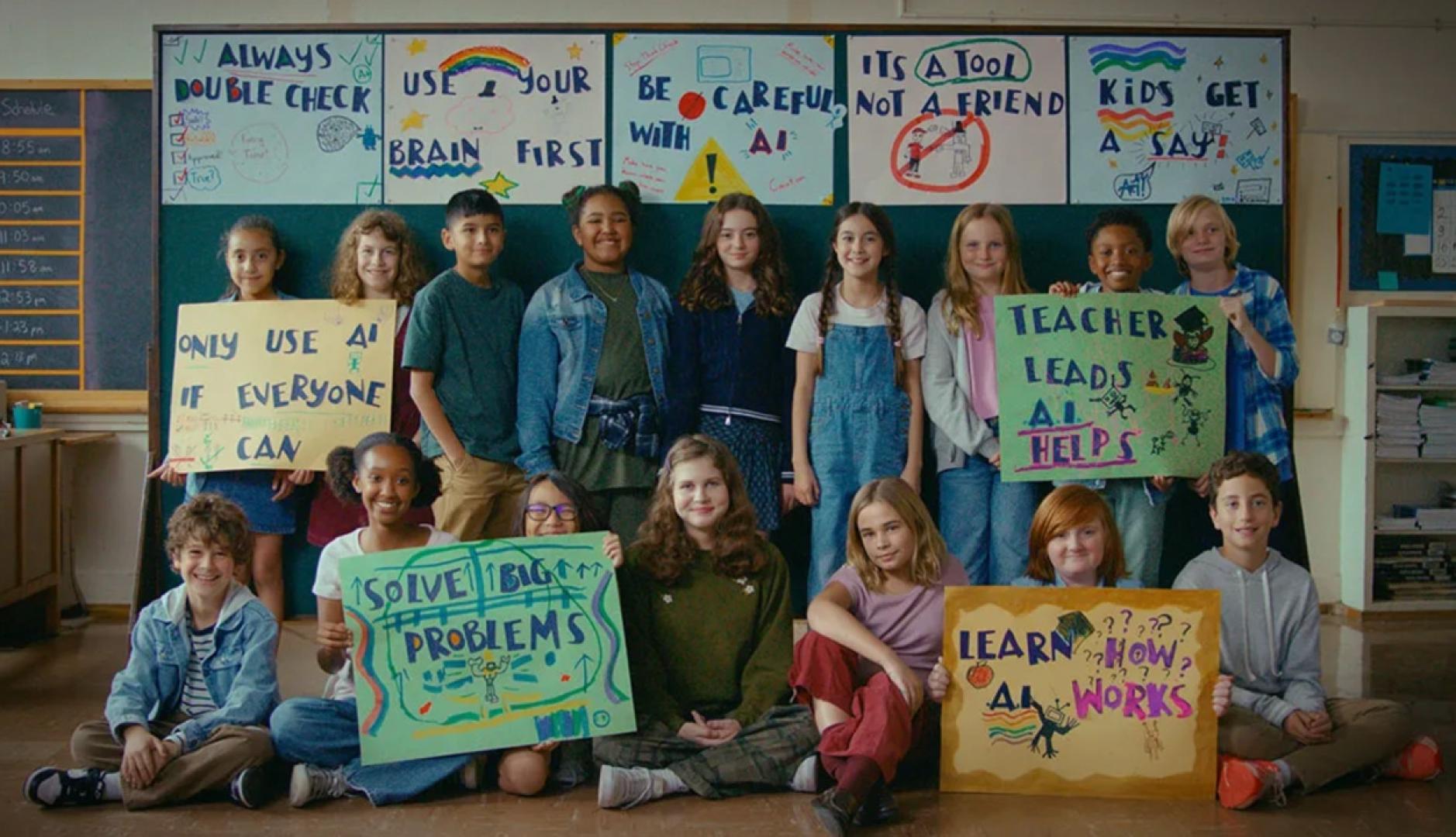
Lego Education has decided to address one of the great educational debates of the coming years from a different position: giving the floor to children. Under the motto “We Trust in Kids”, the educational division of the Danish group has launched a campaign that invites students to reflect on the role of artificial intelligence in school and to write their own rules for responsible use.
The initiative is articulated in a short four-minute documentary, directed by filmmaker Lauren Greenfield and developed together with Edelman, in which a group of students debate AI in class, identify risks and opportunities and end up agreeing on nine basic principles. Among them, that AI should be a tool and not a substitute for human relationships; that it is key to understand how these systems work; and that the responses generated by machines must be contrasted with one’s own criteria.
The launch coincides with the arrival on the market of Lego Education Computer Science & AI – a practical solution for teaching computer science and artificial intelligence in early childhood and primary school that encourages collaboration, creativity and learning among students – but the message goes beyond the product. The campaign is supported by a global report prepared by Lego and Edelman DXI based on surveys of 1,800 teachers and educational leaders in the United States, Germany, South Korea and Australia. The study reveals that, while 69% of teachers consider that AI literacy will be key for students’ future, 40% recognize that their school is not prepared to teach it responsibly.
Another parallel investigation, carried out with the direct participation of children in the design of the questionnaire, points to an underlying problem: 65% of minors claim to feel excluded from conversations about artificial intelligence and 83% perceive that adults completely control how this technology is introduced in the classroom. “Children from different countries shared the same feeling of lack of agency”explains Sean Tindale, brand manager at Lego Education. “We wanted them not to lead the debate, but to have a voice.”
The company emphasizes that the objective is not to present AI as a magic solution or as a threat, but to normalize its learning from an early age, with critical thinking. “Success would be for teachers, educational leaders or administrations to stop seeing AI as something that only distracts or impoverishes learning and begin to understand it as an educational tool, if used with the appropriate frameworks”noted Tindale.
The initiative fits with a broader strategy of the Lego group, which in recent years has reinforced its positioning around children’s digital safety and the responsible use of technology. From partnerships to create safer digital environments to the recent announcement of its interactive bricks at CES in Las Vegas, the brand is moving digital without giving up its historical narrative about creative play.