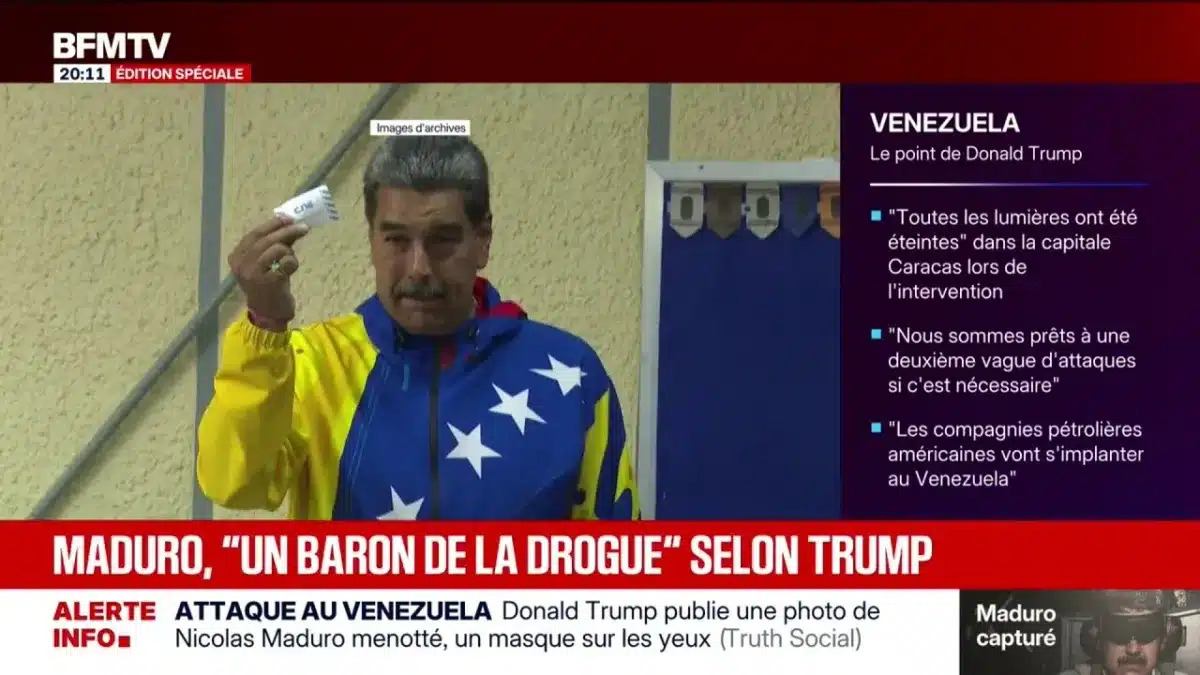
From bus driver to strongman of Venezuela, Nicolás Maduro will have marked the country by a decade of authoritarian power, crisis and international ruptures. On the night of January 3, 2026, Nicolás Maduro, president of Venezuela since 2013, was captured during an operation carried out by American forces in Caracas. He became one of the rare sitting heads of state arrested and then extradited by a foreign power.
The spectacular and controversial arrest by Maduro
In the first hours of January 3, 2026a military operation carried out by the forces of UNITED STATES surprised the whole world. After targeted strikes around CaracasAmerican forces have captured the president of Venezuelaand his wife, Cilia Flores, before immediately transporting them to the United States. The United States now holds Maduro and his wife in Metropolitan Detention Center from Brooklyn, New York.
American authorities accuse Maduro of “narco-terrorism” and of drug trafficking. This intervention, of unprecedented scale, sparked a wave of international reactions. Some leaders have responded, ranging from diplomatic condemnation to calls for Maduro’s immediate release.
Emmanuel Macron has “taken note” from the end of the “Maduro dictatorship”whose “Venezuelan people” can only “to rejoice”in a message published on X.
His main opponent Marine Le Pen pointed out that “State sovereignty is never negotiable, it is inviolable and sacred”while specifying that there were “a thousand reasons to condemn the regime of Nicolás Maduro”.
From bus driver to president of Venezuela
Nicolas Maduro was not destined to become a central figure in Venezuelan political life. Born in 1962 in Caracas, from a modest background, he began his career as bus driver in the capital. Maduro then quickly engages in union activism. It was in the 1990s that he joined the Bolivarian movement ofHugo Chavezrising figure of the Venezuelan radical left.
Close to the future president, Maduro becomes theone of his followersappreciated for his loyalty. After the coming to power of Chavez in 1999, Maduro began a gradual rise. He became a deputy, president of the National Assembly, then Minister of Foreign Affairs from 2006 to 2013a strategic position that allows him to embody Chavista diplomacy and strengthen his ties with the regime’s allies.
At death by Hugo Chávez, on March 5, 2013, the late president designates Nicolás Maduro as his successor. Authorities hold early presidential election in April 2013. Maduro narrowly wins against opposition candidate Henrique Capriles, with approximately 50.6% of the votes. The opposition immediately contested the vote, denounced irregularities and demanded a recount of the votes, which the electoral authorities refused.
Several countries in the region recognize the election, but it permanently establishes Maduro in a fragile legitimacy. Despite numerous unprecedented protests, Maduro manages to stay in power thanks to the support of the armycontrol of institutions and support from certain international allies.
Nicolás Maduro appears this Monday January 5 before a New York judge.