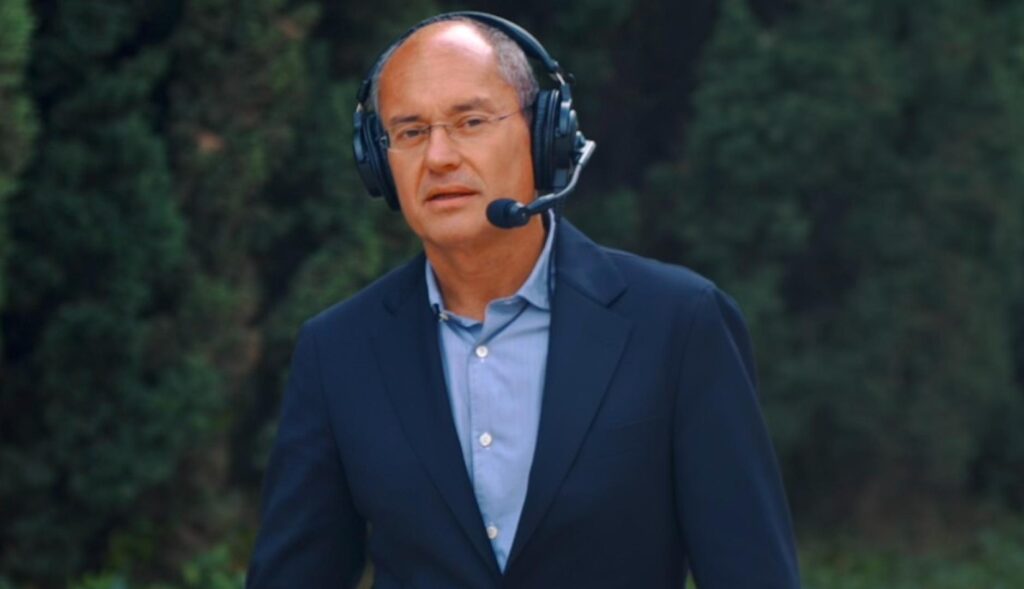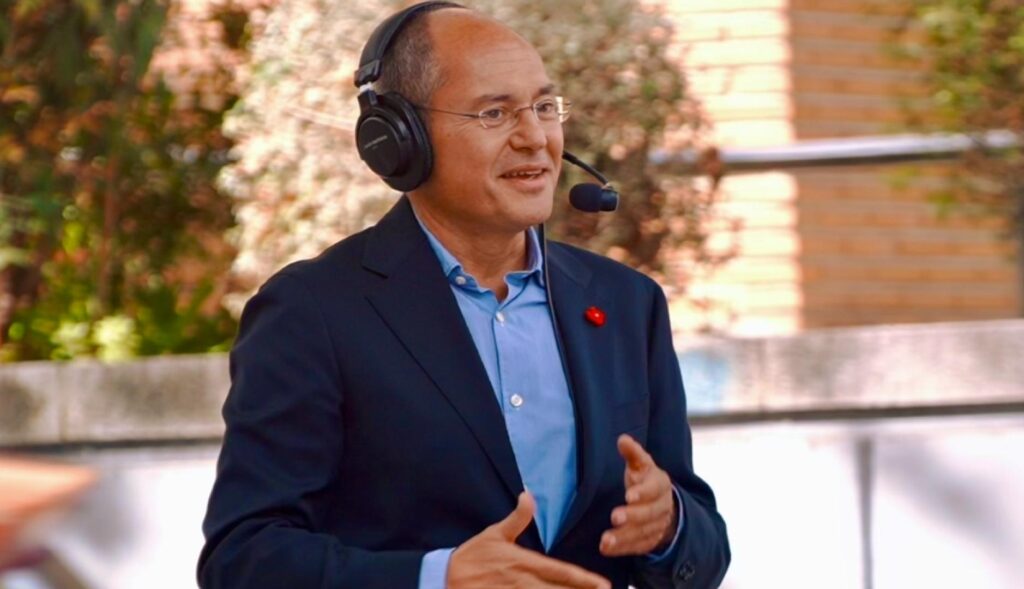
The new campaign of the General Directorate of Traffic (DGT), created by Ogilvy Spain, has opened a debate among advertising professionals about the limits of inspiration, homage and the appropriation of creative ideas. The controversy revolves around the use of the famous hand that starred in the advertisement “Do you like driving?” of BMW, one of the most recognizable images in the history of Spanish advertising, which now reappears in a very different context: a warning about the risks of distractions while driving.
Given the criticism that the proposal has raised, Ogilvy explained in statements to reason.Why that the reference to the original advertisement was deliberate and that its intention was to pay tribute to a creativity that is part of popular culture.
“It is an image etched in fire and we wanted to recover it as a tribute”
“In one of the most iconic advertising campaigns in Spain there was a detail that almost no one interpreted as a mistake while driving. It was that hand sticking out of the window. It is an image burned into the collective imagination and, at Ogilvy, we wanted to recover it for the DGT as a tribute to a campaign that we respect and admire”the agency points out in a brief statement sent to this medium.
The discussion, however, has gone beyond the visual reference and raises the extent to which an institutional campaign can rely on the creative codes of a commercial brand to construct a message of the opposite sign.
And the “If you drive, just drive” campaign, presented at the beginning of November, recovers the image of a hand sticking out of the window of a car and playing with the air while the vehicle moves along a road surrounded by nature.
The scene refers directly to the “Mano” advertisement, created by SCPF for BMW within its “Do you like to drive?” platform. The piece, developed by a creative team headed by Toni Segarra, won the Grand Prize at the San Sebastián Advertising Festival in 2001 and established itself as a benchmark for emotional brand communication. In the original, the gesture conveyed a feeling of freedom, enjoyment and connection with driving without having to resort to the technical features of the car.
From Ogilvy they explain that precisely this familiarity with the image constitutes the basis of their creative approach. “We wanted to take advantage of the power of an image that is already part of popular culture so that drivers would recognize themselves in those small gestures that we make almost without thinking and that can divert our attention from the road. Because distractions are present in one of every three fatal road accidents”adds the agency in its statement to reason.Why.
The campaign has been produced by Little Spain and is scheduled to be broadcast until December 13 on television, cinema, online radio, press, outdoor, digital media and social networks. From reason.Why We are in contact with the BMW team to find out their assessment and to find out if the brand plans to take any action or comment on the matter. We will update this information if we have any news.
For its part, since Joyful Rock -creative agency founded by Toni Segarra Alegre and Luis Cuesta- have expressed on social networks that they prefer to understand the campaign “as a tribute”thus positioning itself against the interpretation of possible plagiarism.
Although a good part of the reactions have focused on the recovery of the hand, the debate has incorporated a second coincidence that affects the verbal concept of the campaign itself. And in 2016 BMW launched a campaign under the message “When you drive, drive”, a formulation extraordinarily close to the current “If you drive, just drive” of the DGT.
The similarity has been pointed out on social networks by professionals in the sector, who consider that Ogilvy’s creativity reinterprets an emblematic image and also recovers a verbal approach previously used by the same brand.
One of the comments that have drawn attention to this circumstance suggests that Ogilvy would have built its proposal from two BMW advertising references: the image of the hand from the beginning of the century and the message of the 2016 campaign. Its author even proposes a name for this combination: “advertising collage”.
Between homage and lack of originality: the opinions of the sector
The discussion has spread on Linkedin, where different advertising and communication professionals have questioned both the originality of the proposal and the convenience of using a symbol so closely associated with a brand to convey a negative message.
“From an agency like Ogilvy we expect its own idea, not one that depends on the memory of another”
Mateo Krauel, brand and event management professional, suggests that being inspired by recognized creativity is legitimate, but believes that reproducing such identifiable codes compromises the originality of the result. “From an agency like Ogilvy, and even more so in an institutional campaign, we expect our own idea, not one that depends on the memory of another”he states. And he summarizes his position with a reflection on the function of creativity: “Creativity should create references, not recycle them.”
Another objection points to the consequences that reinterpretation may have on the perception of the original brand. Gemma Farreras, marketing and communication strategy professional, questions that an image linked for decades to the enjoyment of driving is now used to represent dangerous behavior. “It is not just about having appropriated someone else’s creative idea, which in itself seems very criticizable to me, but about relating an image that in the Spanish collective imagination is closely linked to a specific brand and turning it into a negative message”he maintains.
His reflection ends with a question that summarizes part of the debate:
Is the DGT saying that BMW encouraged reckless driving?
There are also professionals who recognize the conceptual relevance of the reference. José Carlos León, managing partner of El Viso Media, considers it evident that this is an intentional reuse and affirms that the idea makes sense. However, he questions the timing of the campaign and the institutional approach to holding the driver responsible, pointing out that the state of infrastructure should also be part of the conversation about road safety.
Other reactions have been more critical of the execution and the dependence on previous creativity, going so far as to question the quality of the proposal and the process that could have led to it.
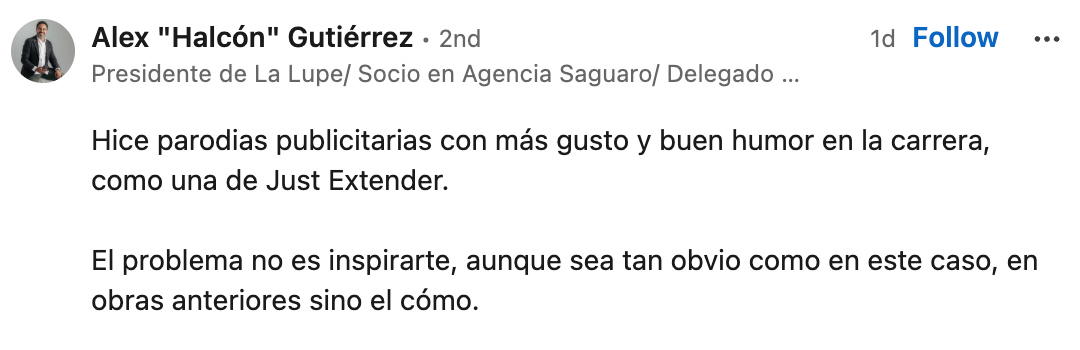
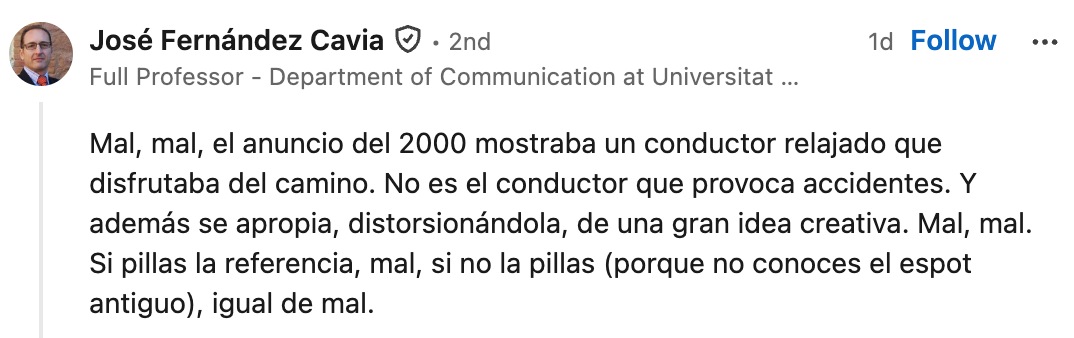
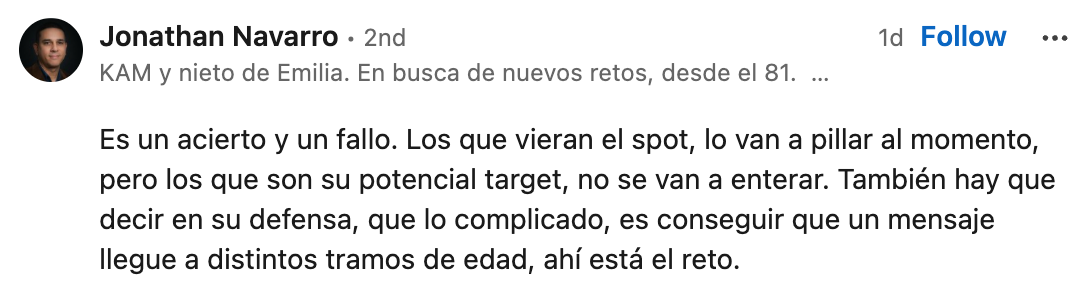
The discussion therefore raises two different questions: whether the reinterpretation manages to make the road safety message more effective and whether the creative resource chosen is sufficiently original and respectful of the work from which it comes.
The controversy has thus opened the debate on how the great references of advertising history are used, reinterpreted and resignified and how far a tribute can go before part of the profession begins to question its originality.