The train accident that occurred on October 28 in Urda (Toledo), between a high-speed train of Renfe and another of Iryohas claimed more than 60 lives and a hundred people injured. A true tragedy in which, as in any major crisis, information and communication have played a key role.
This is how Iryo acted in the emergency:
Iryo’s statements about the accident
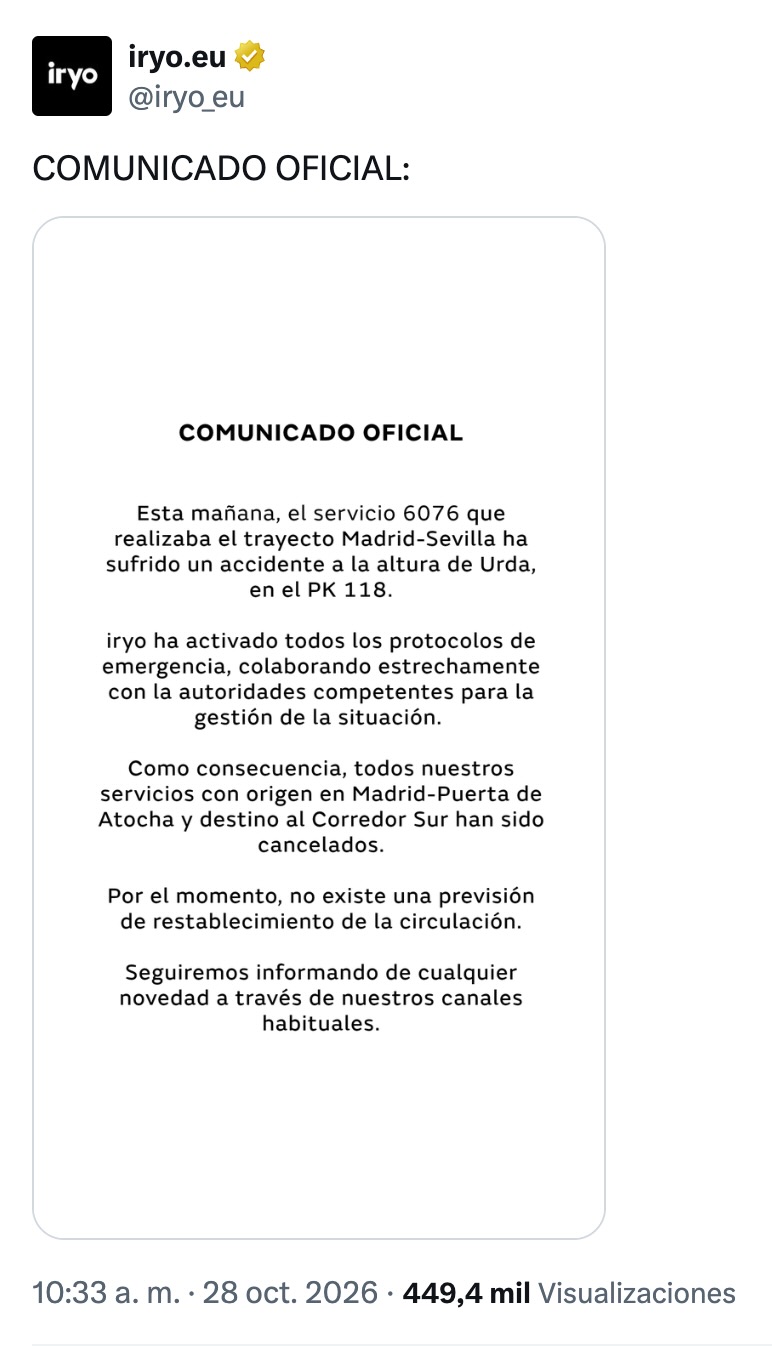
The collision between the two trains occurred, as has been learned, at 08:53 in the morning at kilometer point 118 of the Madrid-Seville High Speed line. The emergency services arrived minutes later at the scene of the accident and, in parallel, the media reported on the news. However, the first message from Iryo related to the emergency did not occur until 10:33, almost two hours after the collision.
Iryo’s first communications were absent of logo
The company identified it as an “Official Statement” and in it it reported, in a neutral tone and technical language, about the events that occurred. An image was used with plain text and no logos that identified the company. “This morning, service 6076 that carried out the Madrid-Seville route suffered an accident near Urda, at PK 118.“, he explained. And he also explained that he had proceeded to activate the emergency protocols and that he was collaborating closely with the competent authorities.
It also announced that, consequently, its services originating at the Atocha station in Madrid and destination “to the South Corridor” had been cancelled, with no provision for restoration of circulation. And he pointed out that they would continue to report news through their usual channels.
The company thus deployed a perhaps overly technical vocabulary that could easily not be understood by all audiences.
Terms such as “service 6076”, “PK 118” or “South Corridor” are an example of this.
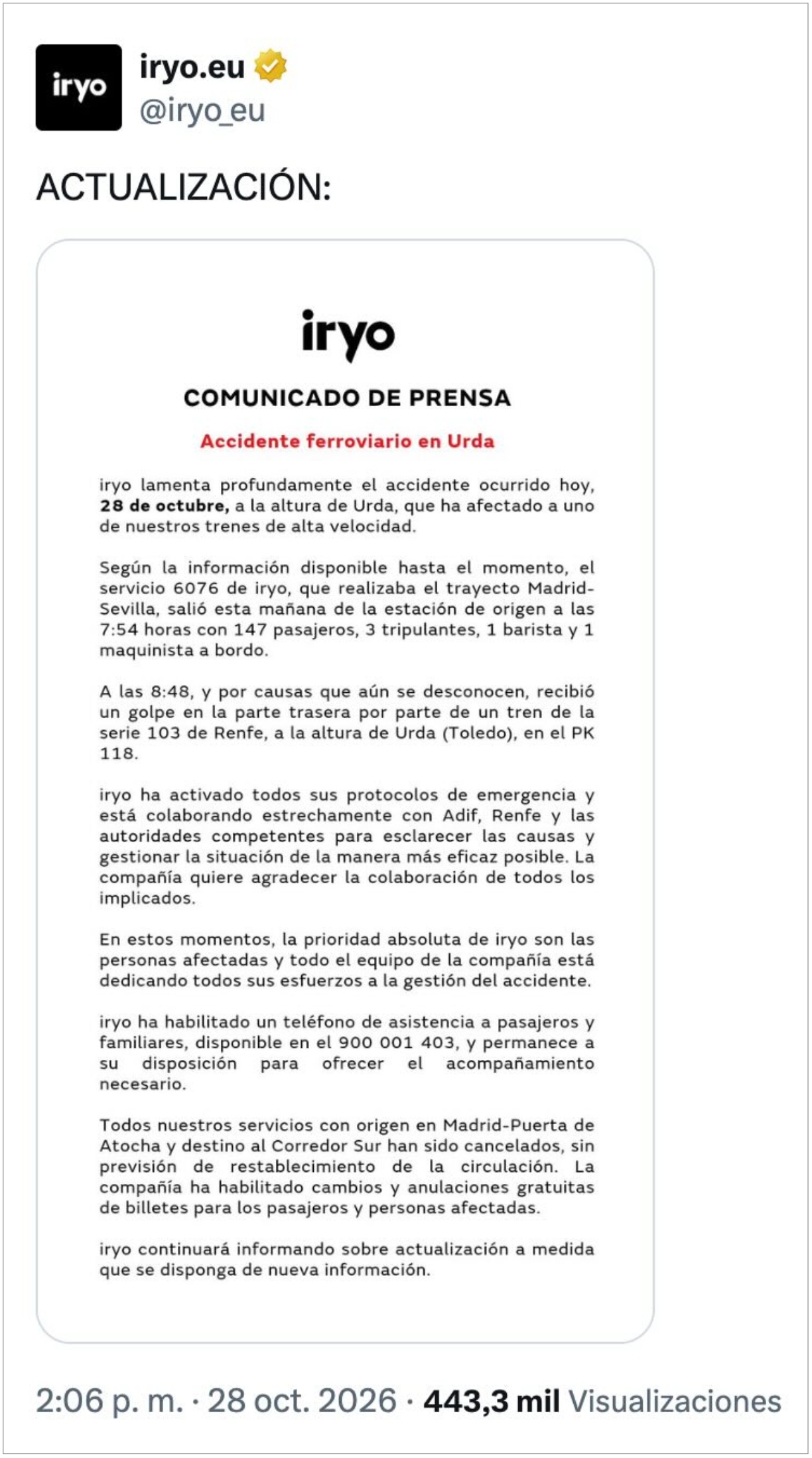
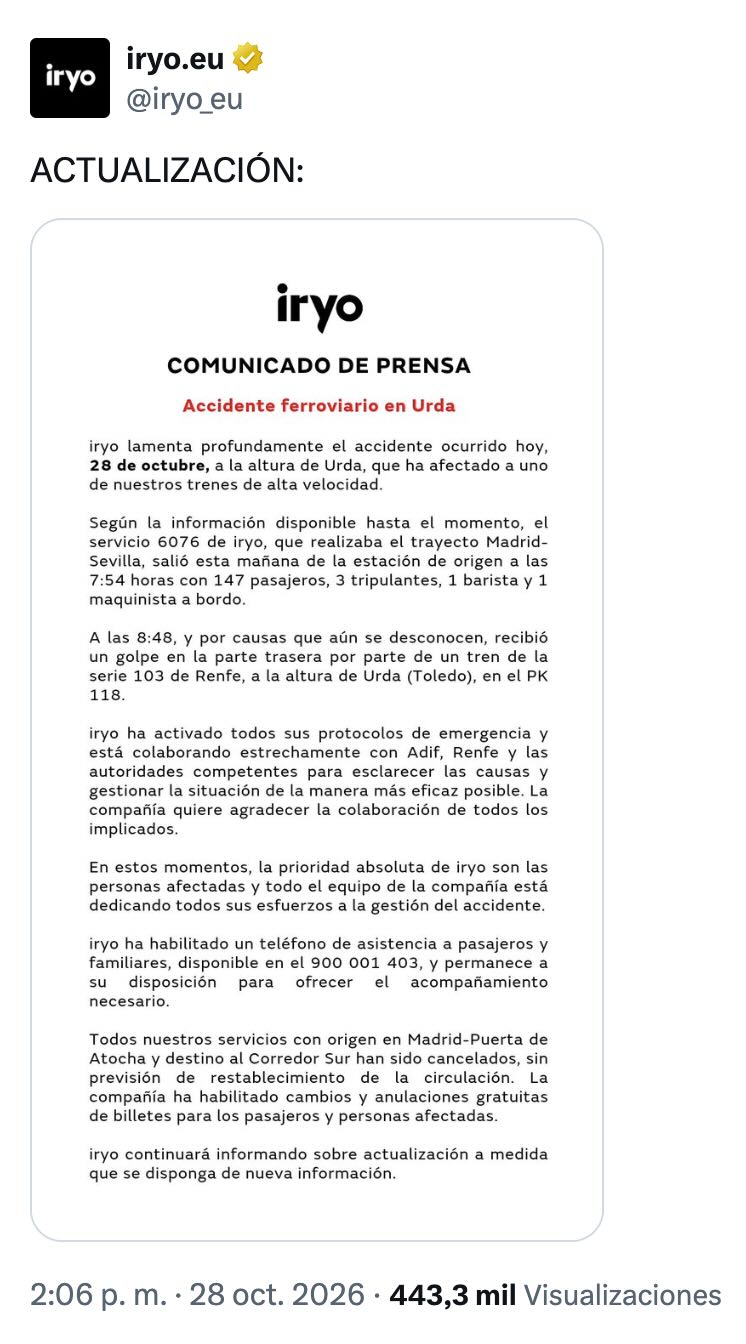
After this, the first press release from Iryo was not published until after 2:00 p.m. In reason.Why We did not receive it at any time, and it was published on social network X at 2:06 p.m., that is, more than five hours after the collision occurred. It had as a heading “Press release: train accident in Urda” and, on this occasion, the Iryo logo was already incorporated, in its black version as a sign of mourning.
He began by regretting the accident “that has affected one of our high-speed trains“It detailed, according to the information that Iryo claimed to have at that time, the departure time of the train and the number of passengers and employees who were on board, as well as the succession of events.”At 8:48, and for reasons that are still unknown, he was hit in the rear by a Renfe series 103 train, near Urda (Toledo), at PK 118.”, he explained.
Once again, it communicated that it had activated the emergency protocols and that it was collaborating with Adif, Renfe and the authorities to “clarify the causes and manage the situation as effectively as possible“But it was not until the fifth paragraph of the text when the victims and those affected were mentioned: “At this time, Iryo’s absolute priority is the people affected and the entire company team is dedicating all its efforts to managing the accident.”, he stated.
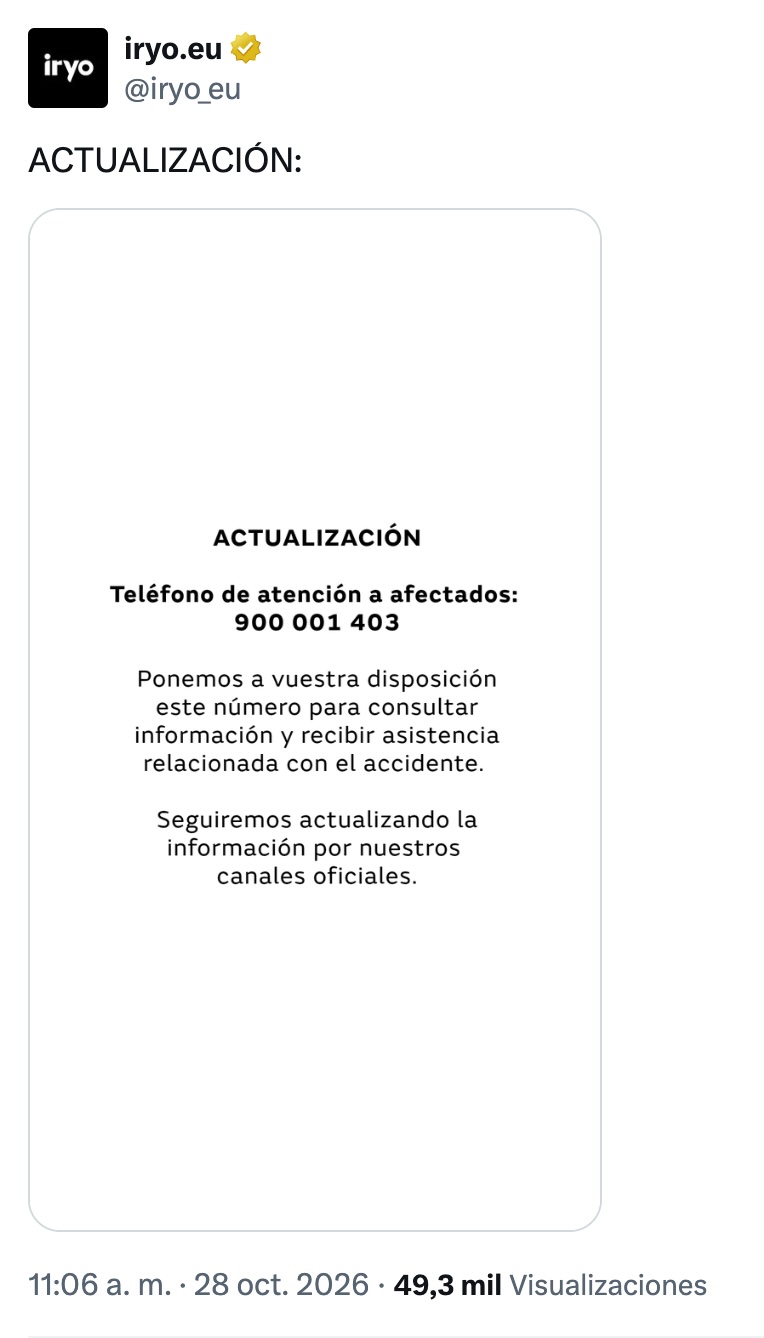
It concluded by informing of the telephone number enabled for passenger and family assistance, as well as the cancellation of services on the affected line and the authorization of free changes and cancellations for tickets. He also promised to continue reporting.
Iryo’s communication on social networks
Communication on social networks also played a fundamental role in Iryo’s information management after the accident. X fue el canal que más actividad registró, principalmente debido a su agilidad e inmediatez y, a diferencia de la gestión realizada por Renfe -en la que las redes se emplearon principalmente como altavoces replicadores de los comunicados- Iryo recurrió a la plataforma para ofrecer actualizaciones informativas periódicas.
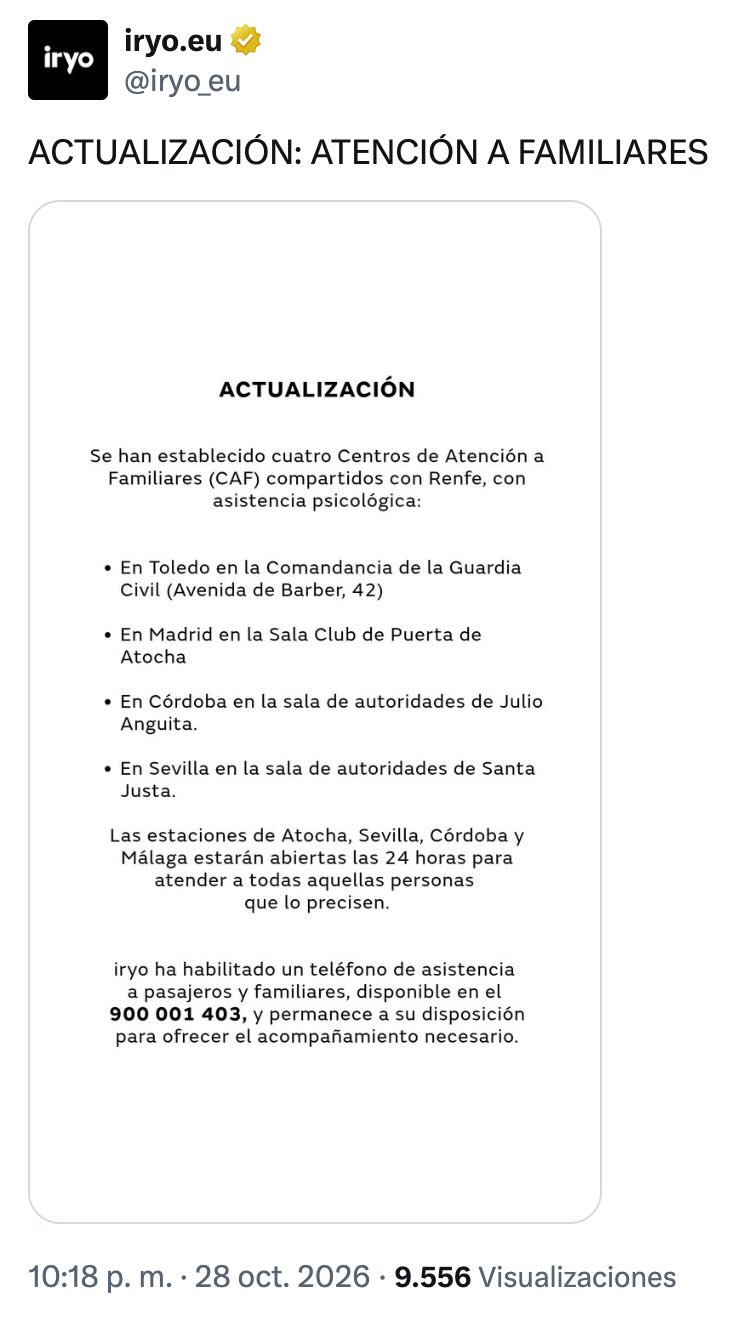
Thus, since the collision occurred and throughout the following hours, the company made up to five publications in The third message corresponded to the also mentioned press release and the fourth was an update related to care for family members. In it he announced the establishment of four Family Care Centers shared with Renfe and once again referred to the helpline.
The fifth update occurred at 7:56 in the morning on October 29, that is, the day after the accident, and reported on the change in location of the center established in Toledo. This was the first message in which Iryo made specific reference to the psychological assistance available to those affected and their families.
Also on October 29, it announced the financial assistance measures.
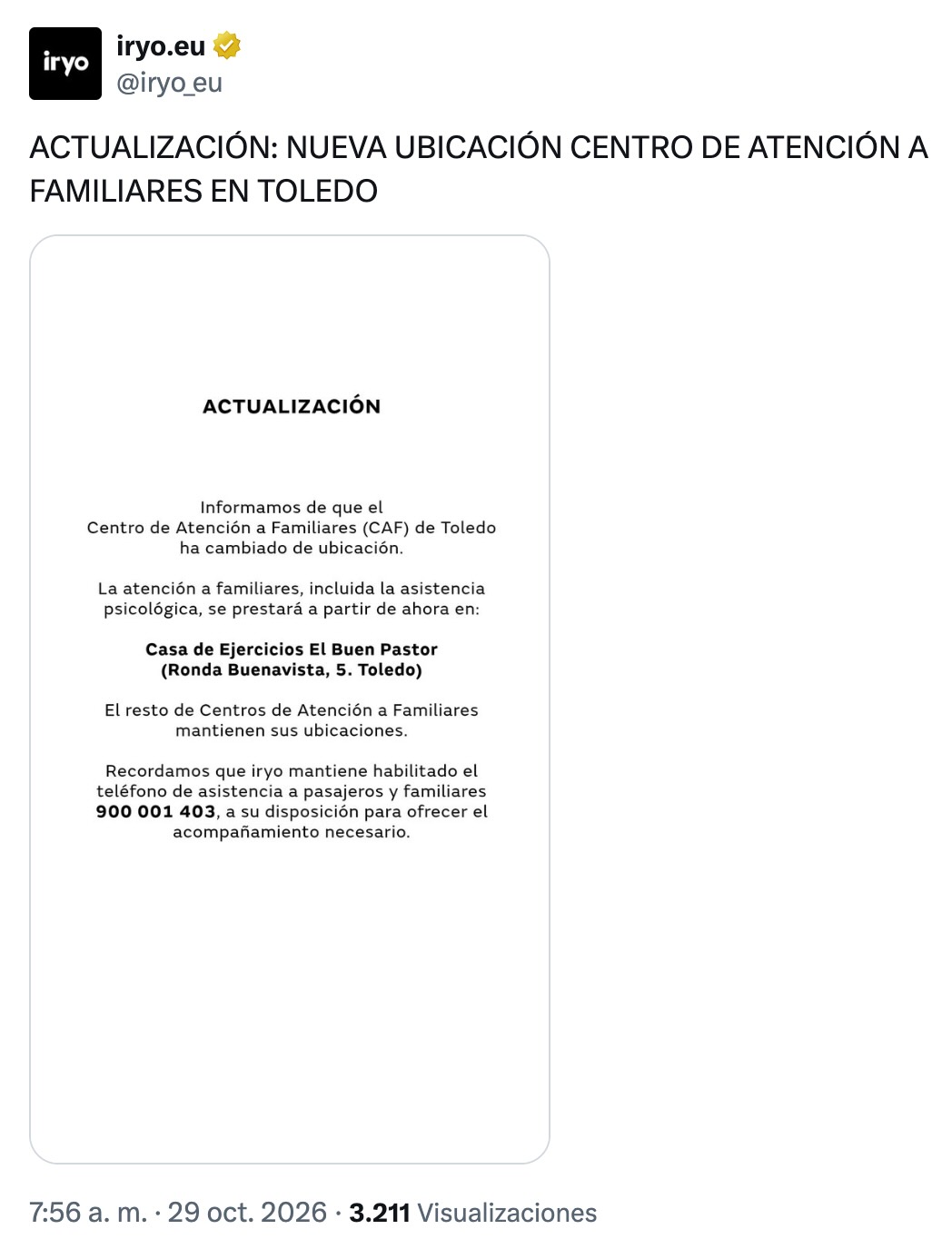
User reactions to the messages spread by Iryo are diverse and reflect a wide range of evaluations and feelings. Some reproach the company for not expressing its condolences for the victims, while others, perhaps because the Iryo train was hit from behind by the Renfe train, encourage the company to sue the State. Others responded to the publications to ask questions or query concerns regarding their upcoming trips or the restoration of service which, however, did not find a response from the company.
Beyond X, the only social network through which Iryo reported the emergency was Instagram, which served as a replicating speaker for the messages shared through the microblogging network. Like Renfe, it opted for the ephemeral Stories format, instead of a fixed publication in the feed.
The company did not make any type of publication on Linkedin, Facebook or TikTok.
It should be noted that the logos of Iryo’s profiles on all social networks were changed to black as a sign of mourning after the accident. In X, however, he kept the header composed of a color photograph of one of his trains. Facebook did not make any aesthetic changes, maintaining its usual red logo.
The contrast to the neutral and technical tone of Iryo’s communication came, however, from the hand of some of its workers. As shared by a user on social networks, the crew addressed the passengers to thank them for their respect, empathy and understanding, also in the face of a particularly difficult day for the company’s staff.
Original post by @lachicadelzapatoahora on Instagram
Iryo’s website also fulfilled a communicative mission and was modified, on an aesthetic and functional level, to accommodate information of interest. Thus, it showed a black header, instead of the usual red, and a message that communicated the accident, as well as the contact methods to receive attention, make claims or make changes and cancellations.
It also dedicated prominent spaces to consult information about possible delays due to temporary speed limitations and traveler insurance.
Click to see the image in full screen
In the days following the accident, Iryo’s website was updated again to include a condolence message that expressed condolences for the deceased, expressed its closeness and wished a speedy recovery to the injured. It also included a new highlighted section with information on financial assistance measures.
Click to see the image in full screen
In addition, the company blocked the sale of tickets on the affected line, preventing them from being acquired, for the moment, until December 13.
Thus, Iryo’s communication in the first hours of the tragedy was aimed at reporting the events and providing assistance to the victims. The company maintained a neutral and technical tone, moving away from emotional tone and allusions to victims. It adapted its visual identity to mourning and used different digital channels to spread its messages, but the use of social networks was mainly limited to dissemination, rather than attention and conversation.
In a crisis of this magnitude, in which information is constantly evolving and uncertainty is especially high, communicating is not just about making periodic updates or issuing official statements; We must also respond to the specific needs of those affected and demonstrate, from the first moment, a human attitude that makes them feel supported.