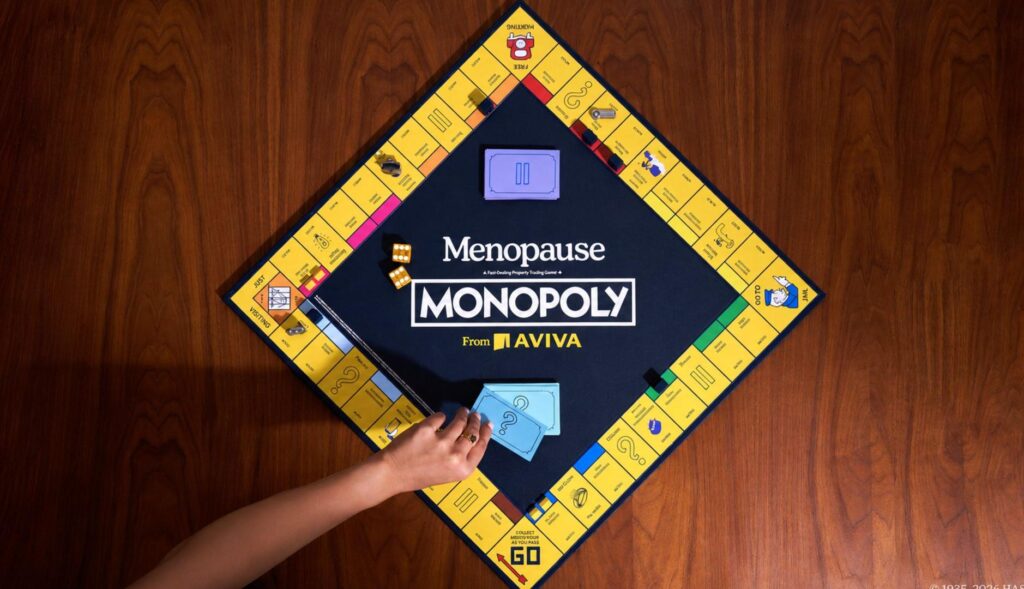
Influence marketing has established itself as one of the main communication tools for brands, but its ability to generate memory raises some questions. Only 25% of Spanish consumers remember having recently seen a collaboration between a brand and a content creator, according to Panorama by Kantar results for the third quarter of 2026.
The data is relevant in a context in which companies continue to expand their investment in this area. According to Kantar, two-thirds of marketing professionals plan to increase their budgets for creators in 2027, especially micro- and nano-creators. And according to the latest data from InfoAdex, influencer marketing was the section that grew the most in advertising investment in Spain in 2025, with an increase of 23% compared to the previous year.
Two-thirds of marketers will increase their creator budget next year
However, the scarce declared memory admits other readings. One of them has to do with advertising effectiveness and the ability of collaborations to leave a recognizable mark. Another, with the identification of the commercial contents: Do consumers not remember collaborations or, in some cases, do they not recognize them as such?
The distinction is relevant because content may have been viewed, generate interactions and even influence consumer preferences without the consumer subsequently identifying it as an advertising collaboration. Therefore, 25% should not automatically be interpreted as a measure of campaign failure, although it does raise questions about its recognition and contribution to the brand.
*Editorial note: The research is part of Panorama by Kantar, a study aimed at the Spanish population between 18 and 65 years old, with 1,200 annual interviews distributed in quarterly waves. The field work for this edition was carried out in September 2026.
Product experience generates more trust than popularity
For a recommendation to be credible, according to Kantar, the main trust factor is that the creator shows real results, mentioned by 32% of consumers. They are followed by having experience or knowledge on the subject, with 26%; actually use the product, with 25%; and clearly explain its benefits, with 24%.
The perception of sincerity and authenticity appears next, with 20%. On the other hand, prior trust in the creator stands at 14%, below the elements directly related to their knowledge and experience.
The results point to a difference between a profile’s ability to attract attention and its ability to generate credibility in a commercial recommendation. Popularity can favor the reach of a campaign, but consumers especially value that there is a demonstrable relationship between who recommends and what they recommend.
In this sense, the study also suggests that informative content and the demonstration of benefits may have a more relevant role than is usually attributed to them in a discipline closely linked to entertainment.
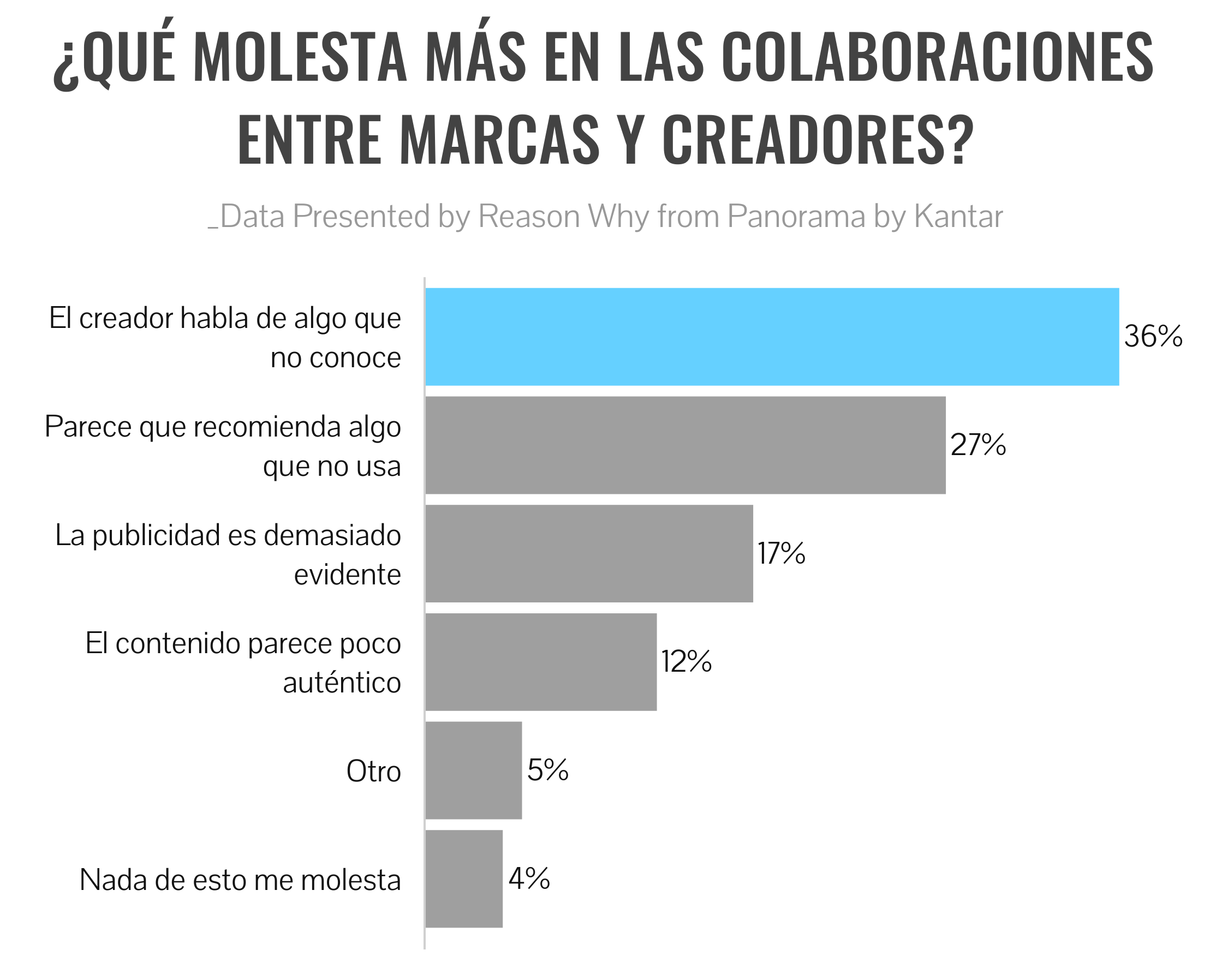
The research also identifies the behaviors that generate the greatest rejection when a brand collaborates with a content creator. 36% of consumers say that what bothers them most is when the creator talks about something they don’t know about, while 27% reject him recommending a product that they apparently don’t use. On the contrary, only 17% mention that advertising is too obvious as their main annoyance. Another 12% point out that the content seems inauthentic.
This difference introduces an important nuance in the debate on advertising identification. Although transparency is a legal obligation, the data also suggests that making the commercial nature of a collaboration visible does not have to harm its acceptance. The consumer seems to show greater sensitivity towards the inconsistency between the creator and the product than towards the explicit recognition that an advertising relationship exists. Therefore, the credibility of a collaboration would not depend so much on its commercial nature going unnoticed as on whether the creator has recognizable reasons to recommend the product and is able to convey them to his or her audience.
The identification of advertising, a pending issue
The difficulty in distinguishing commercial content from editorial is precisely one of the issues that is receiving the most attention from regulators. In Spain, advertising collaborations must be clearly identified. The General Law of Audiovisual Communication and Royal Decree 444/2024 establish specific obligations for creators considered Users of Special Relevance, while the general framework of advertising and unfair competition also requires transparency in commercial communications.
However, the existence of an advertising identification does not in itself guarantee that the consumer perceives it clearly. On social networks, formulas continue to be found in which the indications appear with small fonts, inconspicuous colors or for a short time, especially in audiovisual formats.
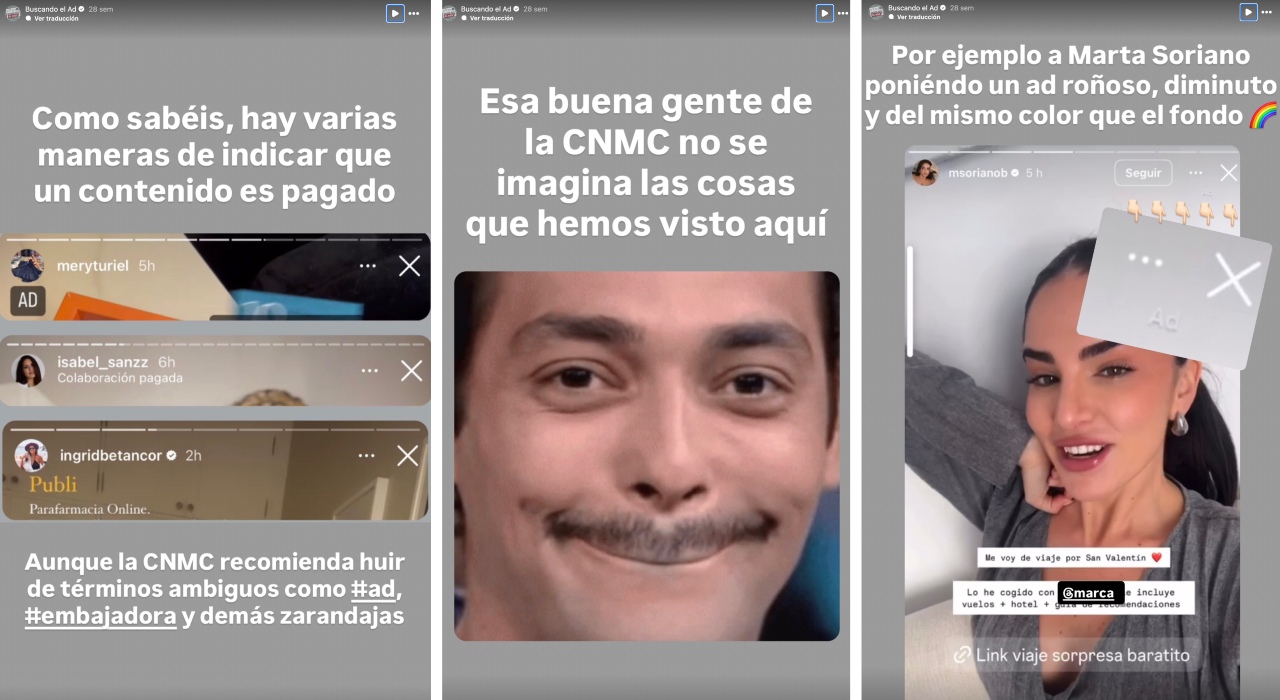
The Instagram account @hazmeunafotoasi has a section titled “Looking for the Ad”
The National Markets and Competition Commission (CNMC) has intensified surveillance of these practices. In February, it put out to tender a contract of almost 180,000 euros to detect covert advertising on social networks and, in July, it sanctioned creators such as Ibai Llanos for not clearly identifying certain commercial collaborations.
Although the Kantar study does not allow low recall to be related to insufficient advertising identification, its results point to another relevant issue: consumers do not seem to reject both the commercial nature of the recommendations and the lack of credibility of those who make them.
Specific collaborations regarding brand building
Beyond advertising identification and the credibility of each recommendation, Kantar’s results allow us to raise another question related to the collaboration model that predominates in influence marketing.
Some of the actions with creators respond to tactical needs such as presenting a launch, giving visibility to a promotion, generating conversation around an event or reaching a specific audience for a limited period.
These collaborations can be useful to achieve immediate notoriety and achieve specific objectives. However, its contribution to brand construction may be different from that generated by relationships sustained over time, especially when actions occur with different advertisers and without recognizable continuity.
Faced with this model, there are associations that have managed to link the image of a prescriber with a brand for a long time. This is the case of Paula Echevarría and Pantene, whose business relationship has recently reached the milestone of 20 years and has allowed the establishment of a recognizable association between the celebrity and the hair care brand.
Publication of @pau_eche on Instagram
These types of agreements offer a different perspective on the role of creators and ambassadors: repetition, consistency and continuity can help strengthen the bond between a person and a brand, although they do not alone guarantee effectiveness. A collaboration can get millions of views and generate conversation for a few days. But if the consumer remembers the protagonist and not the advertiser, or if the association disappears once the campaign is over, it is worth asking to what extent that visibility has contributed to building a brand asset.
The level of engagement and the potential to add value to a brand are only aligned in a third of the cases
The reflection connects with another of the findings collected by Kantar. According to their “The Creator Game Plan” analysis, the level of engagement and the potential to add value to a brand are only aligned in a third of the time. This means that a collaboration capable of generating numerous interactions does not necessarily achieve equivalent results in consideration, differentiation or brand building.
In the industry, platform metrics continue to play a prominent role for campaign evaluation. Followers, views and interactions measure specific aspects of content performance, but they do not on their own provide a complete view of its contribution to the business.
For advertisers, this means expanding the criteria for selecting creators and the indicators used to evaluate collaborations. The actual affinity with the product, the context in which the message is integrated, the clarity of the brand presence and the continuity of the relationship can be as relevant as the size of the audience. “Creator content has enormous potential to connect with audiences, but achieving visibility is not the same as building a brand,” explained Lluís Casas, Head of Creative at Kantar Spain, in a statement. “Consumers trust when they see knowledge, real use of the product and a clear explanation of its benefits. And they reject, above all, collaborations in which there is no credible fit between the creator and what he recommends”he added.
Taken together, the data paint a scenario in which influencer marketing has a growing capacity to reach audiences, but also faces the challenge of demonstrating what remains after each collaboration.
The 25% recall does not allow us to conclude that the campaigns are performing poorly, but it does invite us to ask questions that go beyond the views: if the consumer recognizes the advertising, if they identify the brand behind it, if they consider the recommendation credible and if the collaboration contributes to building a relationship that lasts beyond the immediate impact.