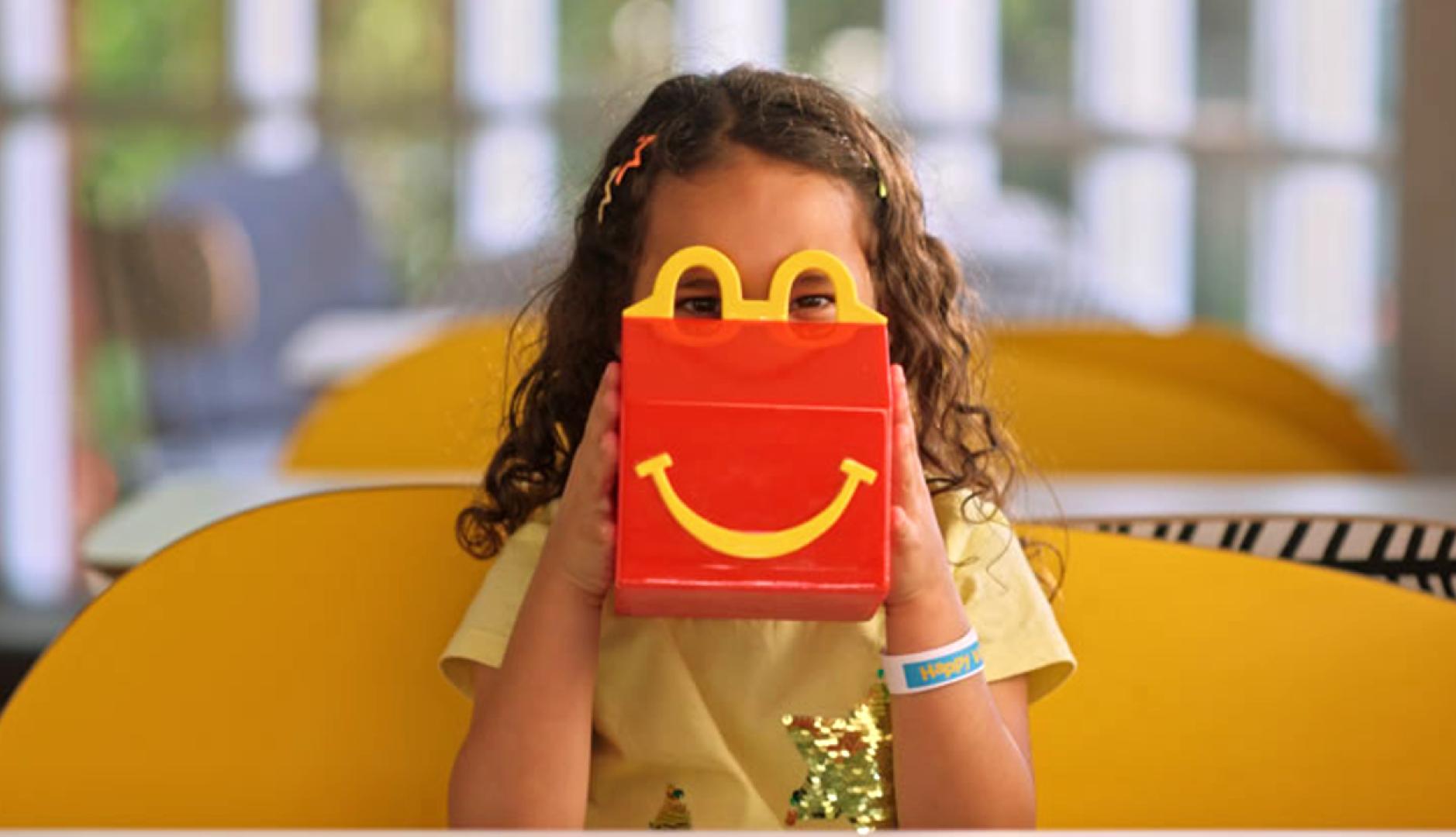
The Happy Meal box has been one of McDonald’s most recognizable elements among families for decades. Now, in Brazil, the company has decided to use that familiarity to give it a different function and help detect possible vision problems during childhood.
McDonald’s and the CEMA Hospital have presented “Happy View”, an initiative developed together with the Galeria agency that transforms the traditional children’s menu box into part of a first playful evaluation of visual acuity. The action thus takes advantage of one of the company’s most recognizable visual codes, inviting children to look through the Golden Arches.
The project coincides with Children’s Month and National Reading Day, which is celebrated in Brazil on October 12, and seeks to draw the attention of families to visual alterations that may go unnoticed during the first years.
According to data from the Brazilian Council of Ophthalmology (CBO) collected by the campaign, around 20% of school-age children present some type of visual alteration. Problems such as myopia, farsightedness, amblyopia or strabismus can evolve undetected and affect learning, socialization and school development.
A box with five lenses to evaluate visual acuity
The special edition is part of a technical kit developed with the advice of the CEMA Hospital. It includes five sets of refraction lenses with prescriptions between +2 and -3 diopters, in addition to the application of the pinhole test.
The experience is divided into two phases. First, the child stands several meters from a special poster based on the LEA test and observes its symbols through the different lenses integrated into the box. The exercise allows you to perform a first screening and identify possible signs of refractive errors.
Afterwards, a fundus examination is performed by professionals from the CEMA Hospital, which allows the retina and other ocular structures to be observed and guides families in case it is necessary to continue with a medical evaluation.
The campaign itself warns that Happy View works as a health promotion action and an initial screening and does not replace a regular ophthalmological consultation.
“Happy Meal is part of the childhood of millions of families and, for us, valuing childhood also means contributing to ensuring that children have the conditions to learn, discover and develop their full potential”explains Ilca Sierra, Marketing Director at McDonald’s Brazil. The directive highlights that vision plays a fundamental role in this process and indicates that the intention is to use “strength and familiarity” from one of the company’s icons to introduce eye health into family conversations and encourage parents to pay attention to it from the earliest years.
McDonald’s and CEMA Hospital will offer free eye check-ups for children
Happy View is not limited to the box design. McDonald’s and CEMA Hospital will offer free eye check-ups for children between 3 and 13 years old on October 10, 11 and 12. The evaluations will be carried out by hospital specialists between 11:00 a.m. and 5:00 p.m. at the McDonald’s restaurant located on Henrique Schaumann Avenue, in São Paulo. The location is part of the approach of the initiative: to transfer a first approach to health prevention from the medical environment to an everyday space for families.
“The creativity of bringing health services to the places where families are allows us to reach exactly the public that most needs awareness”says Sandro Ribeiro, ophthalmologist at CEMA Hospital. In his opinion, the collaboration with McDonald’s provides a platform to make visible the importance of taking care of vision during childhood.
From the CEMA Hospital they also focus on the role of cobranding. Cesar Augusto Cunha, Director of Market Relations of the institution, considers that the initiative uses the reach of both brands to bring a prevention message to people’s routines.
The initiative has been in development for more than a year by the creative team at Galeria, the agency responsible for the McDonald’s account in Brazil.
“Happy View was born from the question of how we could use familiarity to put this topic in the conversation of families and draw attention to a problem that can remain invisible precisely at a decisive stage of development”explains Rodrigo Marangoni, Executive Director of Creation at GALERIA.
The prototype has been developed jointly by Galeria and the creative hub Magic Lab, with the medical consultancy of the CEMA Hospital. Sphera Comunicação e Reputação, responsible for the hospital’s brand strategy, has also participated in the project.