Artificial intelligence is accelerating content production, information analysis and process automation, but this transformation is not taking away space from in-person experiences. Rather, something different is happening: as the ability to automate communication increases, brands seem to attach more importance to those spaces where the relationship between people constitutes precisely the product.
Events are consolidated as a discipline that transcends specific activation to integrate into brand objectives
It is one of the readings left by “AEVEA Pulse 2025”, the study by AEVEA (Associated Spanish Event Agencies) on the state of experiential marketing in Spain. The report incorporates both the perspective of agencies and brands and confirms the consolidation of events as a discipline that transcends specific activation to be integrated into brand, business, loyalty and corporate culture objectives.
The data that best expresses this change is that 92% of companies consider events a strategic or relevant channel. Specifically, 45% already place them in the core of their strategy and 47% define them as a relevant channel. Among its main objectives are positioning and notoriety (74%), loyalty (47%), business generation (45%) and corporate culture (34%).
From achieving impact to demonstrating impact
The evolution affects the weight that events have within the marketing mix and also what companies hope to obtain from them. The attendee experience is already the main indicator of success for 71% of brands, closely followed by the impact on business, with 68%.
Behind them are the internal impact on the organization (34%), content generation (18%) and public relations (16%). The impact, therefore, continues to be part of the equation, but it ceases to explain by itself the return of an experience. The event is contemplated from aspects such as what relationship it builds, what business it generates and what effect it has on clients, employees and the organization.
This also explains why events are acquiring an internal dimension. The study points to its use to strengthen corporate culture, promote a feeling of belonging and align teams with the companies’ purpose. As the report itself summarizes, “The greater the automation, the greater the value of experiences capable of bringing people together and generating lasting bonds.”
AI transforms agencies, but brands still ask for ideas
The apparent paradox becomes even more evident when looking at innovation expectations. AI is by far the biggest change agencies have experienced over the past year, according to 66%. Its application is being felt especially in planning, process optimization, content generation and information analysis.
Its implementation, however, is still maturing. 55% of the agencies are at a medium level of adoption, 32% remain in an initial phase and only 14% consider they have reached an advanced level.
Among brands, the journey is even greater: 45% are exploring the possibilities of AI, 29% are carrying out pilot tests and only 13% declare recurring use. 10% indicate that they do not use it.
50% of companies expect agencies to innovate in new narrative and creative formats
But perhaps the most significant data appears when those same companies are asked where they expect agencies to innovate. 50% point out the new narrative and creative formats; 32%, innovative experiences; and 21%, greater strategic capacity. Only 10% mention AI personalization.
Technology, therefore, appears as an infrastructure for transformation and efficiency, but not necessarily as what a brand is willing to choose a proposal for. “Artificial intelligence is changing the way we work, but decisions continue to be made by people and brands continue to build relationships between people”says Mariano Rodríguez, President of AEVEA.
This human dimension is also transferred to the commercial relationship itself. 58% of companies regularly work with a trusted partner and, when choosing an agency, trust in the team and the relationship built constitutes the most valued criterion for 37%. This is followed by the capacity for technical and logistical execution (26%), creativity (18%) and cost optimization (13%). The data points towards less transactional relationships in a context in which projects increasingly require more business knowledge, coordination and strategic capacity.
The report also projects this evolution over the coming years. Together with AI, it identifies content creation and storytelling, 360º communication, measurement of ROI and sustainability and ESG criteria as lines that will mark the future of experiential marketing.
Pressure on talent and profitability grows
Economic photography accompanies this consolidation. 73% of agencies improved their results during 2025, 68% met or exceeded their objectives and 70% plan to continue growing in 2026. One in five agencies (20%) organized more than 200 events during the last financial year and 59% expect to expand their workforce.
Conventions continue to lead the formats with the highest demand (59%), followed by product and brand presentations (54%), road shows (45%) and fairs (39%). Automotive, pharmaceuticals and food and beverages are among the sectors with the greatest activity, along with tourism, luxury and energy.
Growth, however, has two important counterpoints. The first is talent: more than 84% of agencies recognize difficulties in incorporating specialized professionals, especially in production, project management, creativity, strategy and business development.
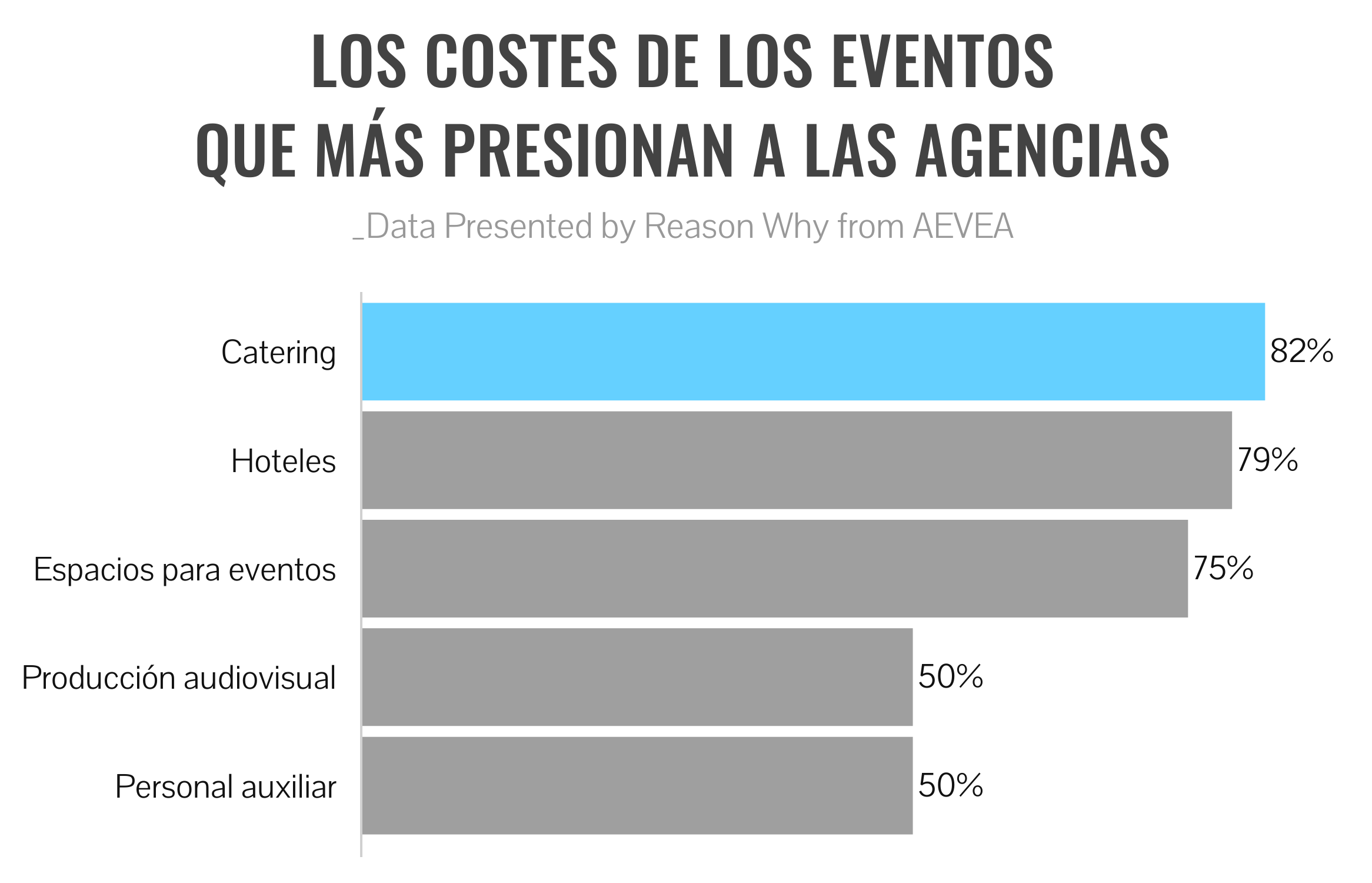
The second is profitability. The agencies point out especially pronounced cost increases in catering (82%), hotels (79%) and event spaces (75%), as well as audiovisual production and auxiliary personnel (50% in both cases). Growing, the study warns, is no longer enough: the challenge is to do so while protecting margins without sacrificing the quality and creativity that brands precisely demand.
AEVEA Pulse thus depicts a market in a particular phase of maturity: technology is modifying how events are conceived, produced and measured while, by contrast, increasing the value of what is most difficult to automate. Creativity, trust, strategy and the ability to generate a shared experience appear as the terrain on which AI can add value.
“The future of marketing will be increasingly technological, but the success of brands will continue to depend on their ability to excite. And there events have an irreplaceable role”concludes Rodríguez.