
Having an artificial intelligence buy for yourself, without human intervention, is something that 79% of consumers are not willing to do right now. The figure is the reflection of a social resistance, which condenses the current relationship between technology and consumption: AI is used, but it is not accepted as a substitute for one’s own judgment.
This rejection of delegation coexists with an increasingly widespread adoption. 77% of consumers have used artificial intelligence tools, although unevenly: only 13% do so daily, while the majority maintain intermittent use, either weekly (31%) or occasionally (33%). Of course, 23% have never used it. And it is this combination between the growing use and rejection of automation that defines the current moment in commerce: technology is integrated into the process, but not legitimized for the decision.
The growing use of AI but the rejection of automation define the current moment in commerce
The study that allows this photograph to be drawn is the “Observatory of human attitudes in new purchasing environments”, prepared by the agencies MRM and Tribal, both part of Omnicom Advertising. It is based on 1,205 online interviews carried out in December 2025, with a representative sample of the Spanish population by age and sociodemographic variables.
The approach, in addition to taking the pulse of the use of AI among consumers, is to understand how the technology is perceived, what fears it generates, what expectations it arouses and what conditions determine its acceptance.
A consumer who uses AI, but does not trust it
The lack of legitimacy of artificial intelligence is reflected in its real influence on the purchasing process. For most consumers, its impact remains limited. Thus, 62% consider that AI has little or no influence on their purchasing decisions (34% little and 28% not at all), compared to 27% who recognize some influence and only 11% who perceive a high impact. Even among the youngest segments, where penetration is greater, significant influence remains a minority.
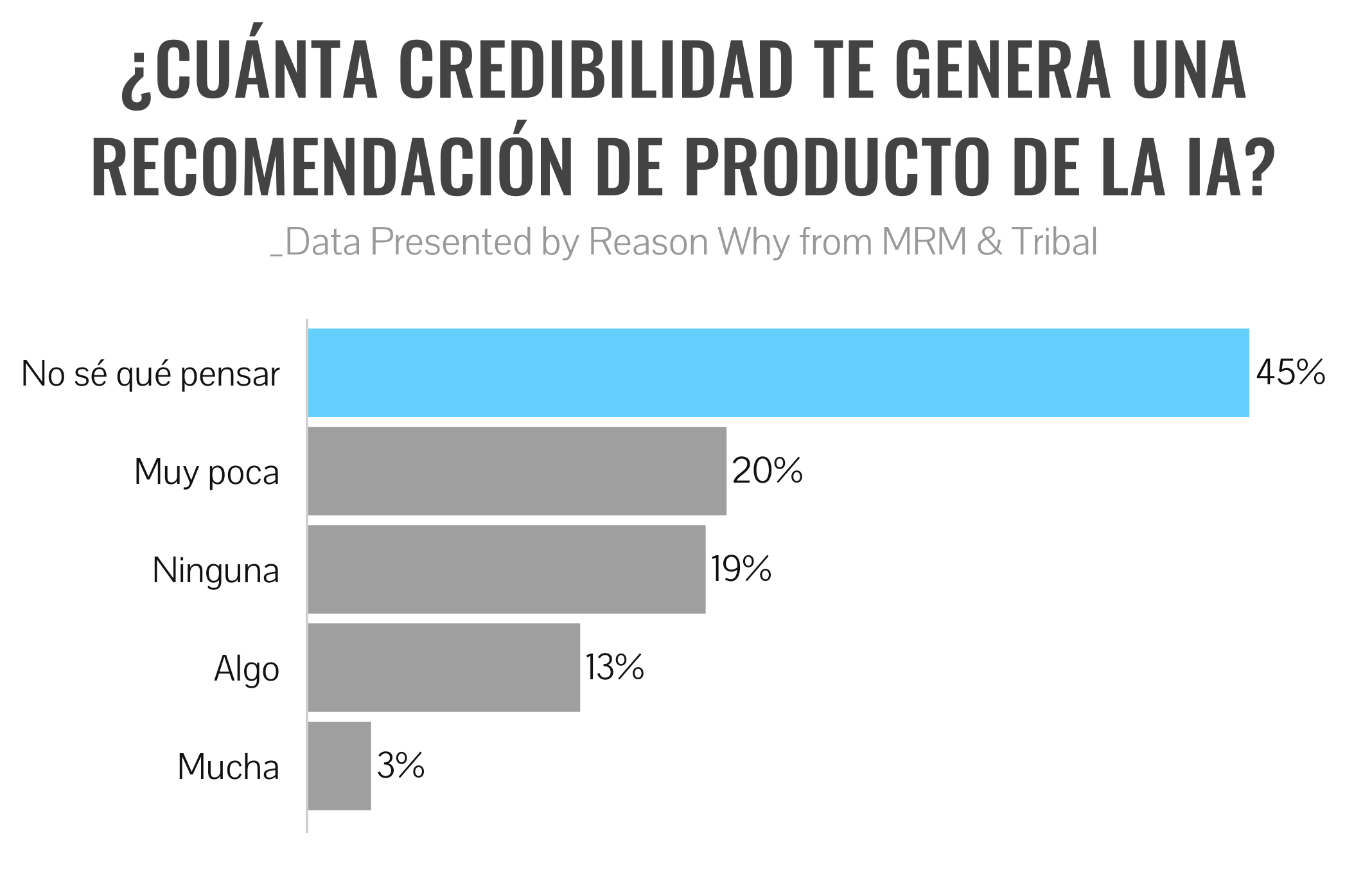
This low impact is directly related to an underlying problem: trust. Almost 40% of consumers do not trust recommendations generated by AI. Specifically, 19% do not grant it any credibility and 20% very little. Regarding this bloc, only 16% give it some or a lot of credibility, while the largest group – 45% – admit that they do not know what to think.
The data is especially relevant because it is maintained even among the most advanced profiles. Even intensive use does not correct mistrust, so only one in three heavy users consider these recommendations reliable.
A gap is thus created: AI is present in the purchasing process, but has not reached the status of a legitimate source of decision.
This distrust is articulated around very specific concerns. The study shows that 9 out of 10 consumers accumulate at least three concerns about the future of commerce, which shows a general climate of caution .
The main concern is the loss of privacy and the use of personal data, indicated by 45.6% of respondents. This is followed by the dehumanization of the shopping experience (39%) and the difficulty in distinguishing what is authentic from what is manipulated – such as fake reviews or deepfakes with 36.7%.
From there, other tensions emerge that point in the same direction, such as loss of control. 31.9% fear technological dependence, 21.1% fear that AI decides for them more than they want, and 20.6% fear that algorithms influence their decisions without them realizing it.
Even concerns such as inequality in access to technology (23.2%) or the concentration of power in a few companies (19.8%) are part of the consumer’s imagination.
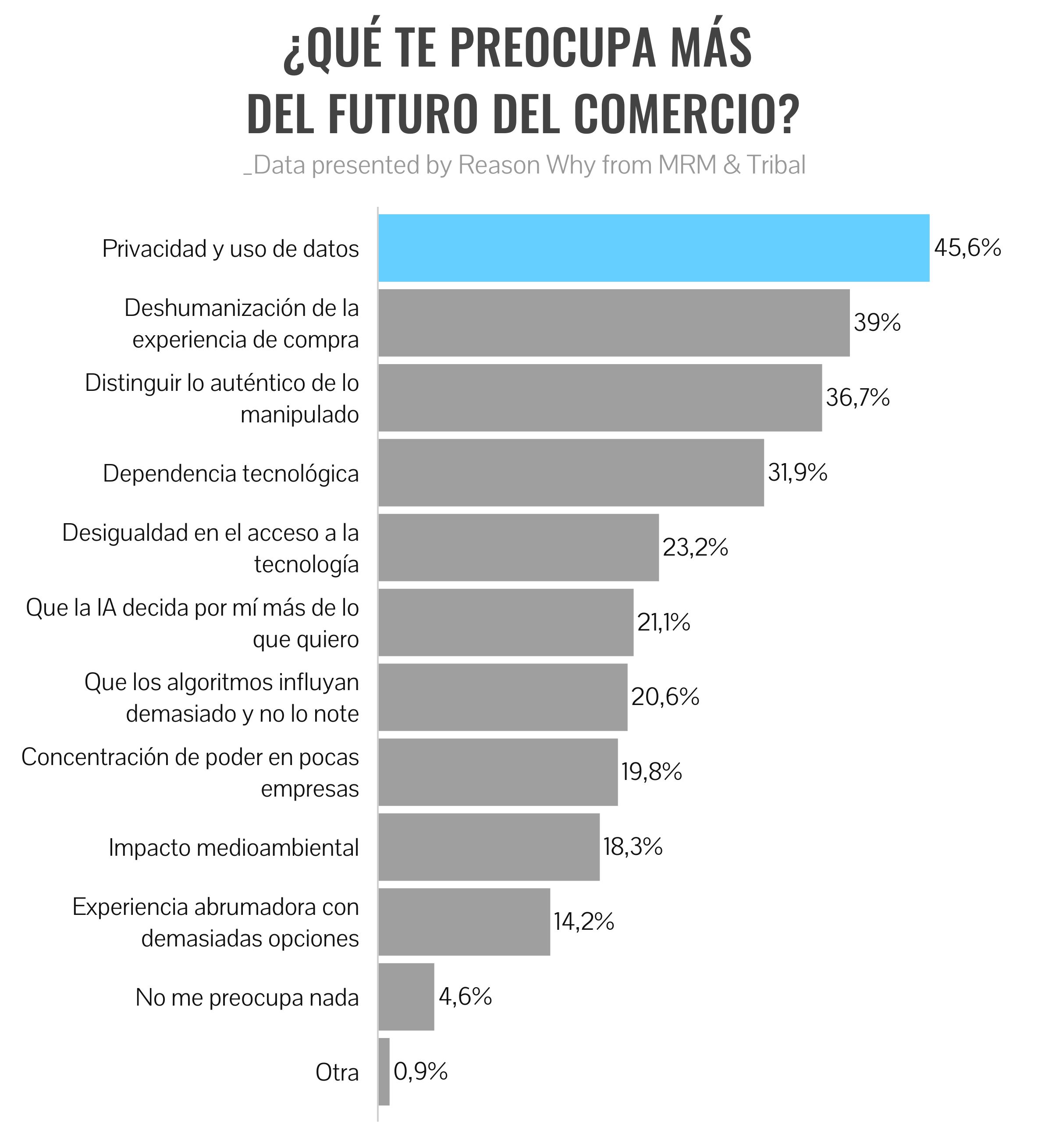
What is relevant about these concerns is, furthermore, their transversality. Because it is not a generational rejection or less digitalized profiles: these concerns cut across all segments, including the most intensive users.
AI as a useful tool, but with clear limits
Despite this context, the study does not point to a frontal rejection of artificial intelligence. The short term involves a redefinition of its role. And the consumer is willing to accept help, but under certain conditions. The most important: that AI does not replace your decision-making capacity.
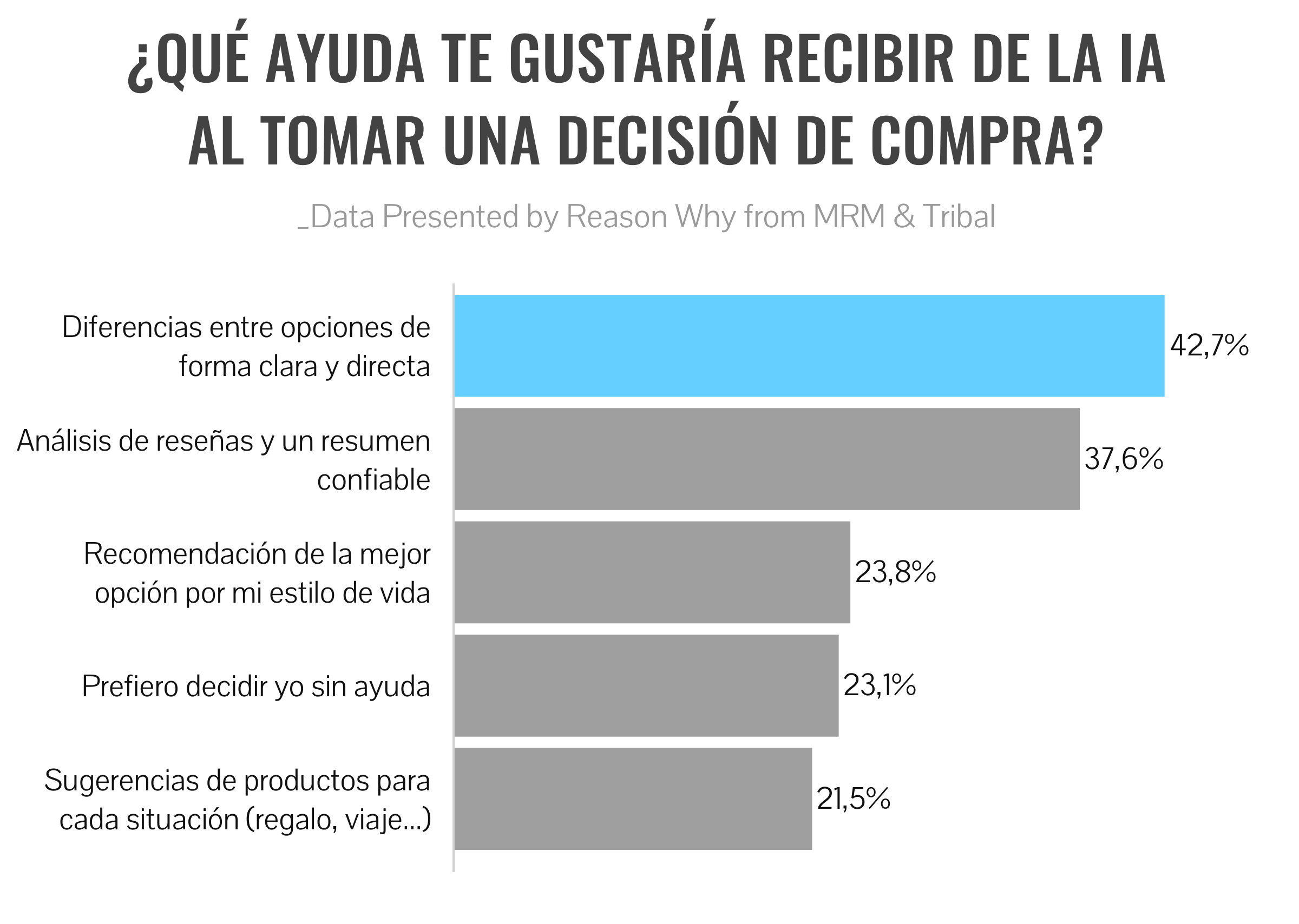
When considering what type of support is valued, 42.7% want AI to explain the differences between options clearly, and 37.6% want it to analyze reviews and provide a reliable summary. On the other hand, only 21.5% show interest in directly recommending what to buy. The majority preference is, in fact, an accompaniment model. 55% accept the role of AI as an “advisor”, while only 2.9% would be willing to have a completely autonomous system. 29.3% prefer that he not intervene at all.
On the other hand, more than half of consumers feel uncomfortable purchasing directly through a conversation with AI, and rejection increases when technology invades sensitive areas such as emotions or constant listening.
Clear limits also appear on the economic level. Although there is some openness to alternative models – such as paying over time (49.6%) or collaboration (35.4%) – only 15.2% would accept paying with their personal data.
The conclusion in all indicators is, therefore, that efficiency cannot prevail over control.
The human factor as an anchor of trust
From the MRM and Tribal study it is clear that the role of people continues to be decisive. 60% of consumers consider it important to be able to turn to a human during the purchasing process, especially at critical moments such as before payment (50.5%) or in case a problem arises (59.3%).
Furthermore, the main generators of trust continue to be human or verifiable elements: immediate attention (62%), the opinions of other consumers (61%) and expert recommendations (58%). In this context, artificial intelligence can optimize the process, but it does not replace the need for backup.
The Observatory thus draws a transition scenario in which artificial intelligence has managed to be integrated into the purchasing process, but has not yet managed to build a solid relationship of trust with the consumer. Use is growing, but influence remains limited. Technology is perceived as useful, but not reliable. And, above all, there is a clear resistance to giving up control of the decision.
The future of commerce is at stake in this imbalance. Not in AI’s ability to automate more tasks, but in the ability of the ecosystem – brands, platforms and technology – to build credibility and transparency, offering people a sense of control.